UPSC CAPF AC Syllabus 2026 and Exam Pattern, Check Syllabus Topics

Central Armed Police Force Assistant Commandant Exam (UPSC CAPF AC Exam) is conducted annually to recruit eligible candidates for Grade A Officers (Assistant Commandants) for the BSF, CRPF, CISF, ITBP, and SSB. Candidates must understand the detailed UPSC CAPF AC Syllabus and Exam Pattern 2026 to excel in the UPSC CAPF AC Exam. Knowing the syllabus helps candidates plan their preparation effectively and focus on the important topics. Check the topic-wise syllabus below to know the subject-wise weightage, marks distribution, and official exam pattern.

UPSC CAPF AC Syllabus and Exam Pattern 2026

UPSC CAPF AC Notification 2026 PDF will be released in February 2026, and UPSC CAPF 2026 will be conducted on 19th July 2026. The UPSC CAPF AC Syllabus comprises two papers. Papers 1 from General Ability and Intelligence and Papers 2 from General Studies, Essay, and Comprehension. Knowing the Syllabus is the first step to begin preparation for the exam and plan a proper exam strategy for the examination. 

UPSC CAPF AC Syllabus 2026
ExaminationCentral Armed Police Force Assistant Commandant Exam (UPSC CAPF AC Exam)
OrganisationUnion Public Service Commission
UPSC CAPF AC Exam Date 202619th July 2026
SelectionThree rounds
First RoundPaper-I based on General Ability and Intelligence (Objective)Paper-II based on General Studies, Essay and Comprehension (descriptive)
Negative MarkingOnly for Paper-I of first-round; (0.33) marks deducts for each wrong answer
Second roundPhysical Ability Test
Third roundInterview/Personality Test

UPSC CAPF Notification 2026 Out for 349 Vacancies – Click to Check

UPSC CAPF AC Selection Process 2026

The selection process includes written exams, physical standards/physical efficiency tests, medical standards tests, and interview/personality tests. The final selection will be based on marks obtained by the written exam and interview/personality test. 

  • Written Examination 
  • Physical test
  • Interview

UPSC CAPF Exam Pattern 2026

The UPSC CAPF 2026 written exam is the first stage for the selection of candidates for the next round. The exam is conducted to shortlist candidates for the Physical & Medical Standards Test. The exam is held based on the exam pattern, which is notified by the UPSC in the official notification.

  1. Papers I & II will be in bilingual language & English, excluding the English paper
  2. Paper I is of 2 hours duration, and Paper II is of 3 Hours duration
  3. Paper- I will consist of Multiple Choice Questions (MCQ) with a negative marking of 1/3rd marks for each wrong answer
  4. Paper II is in a descriptive format
  5. Paper-I is a qualifying stage; Paper-II will only be checked for those candidates who clear the Paper I
UPSC CAPF Exam Pattern 2026
Paper NameTime DurationMarks
Paper- I  General and Mental Ability2 hours250 marks
Paper-II  General Studies, Essay and Comprehension3 Hours200 marks
Total450 marks
UPSC CAPF Exam Pattern 2026
ParticularsPaper-IPaper-II
Name of PaperGeneral Ability and IntelligenceGeneral StudiesEssayComprehensive
Total Marks250200
Duration of exam2 hours3 hours
Number of Questions1257
Marks for each correct answer250
Negative Marking1/3
Type of PaperObjectiveDescriptive format

UPSC CAPF AC Syllabus 2026 for Paper 1

UPSC CAPF AC exam has two papers. The UPSC CAPF Paper-I includes General Ability & Intelligence, and Paper-II includes General Studies, Essay & Comprehension. Where total marks for both papers are a maximum of 550. In this section, questions will be asked on the below-mentioned topics. Let’s now have a look at the detailed Syllabus of Paper-1 and Paper-2 of the UPSC CAPF 2026 Exam:

Paper 1: General Ability & Intelligence

UPSC CAPF Paper 1 consists of questions from General Mental Ability, General Science, Current Affairs, Indian Polity, Indian History, and India & World Geography. Check the section-wise UPSC CAPF Syllabus 2026 from here and prepare accordingly for the examination. 

General Mental Ability

The UPSC CAPF Paper-I will have a written test that covers the following important General Ability topics and subjects, including General Mental Ability.

  1. Logical Reasoning
  2. Quantitative Aptitude
  3. Numerical ability
  4. Data Interpretation

General Science

  1. General Awareness
  2. Scientific Temper
  3. Comprehension & Appreciation of Scientific Phenomena
  4. Information Technology
  5. Biotechnology
  6. Environmental Science

Current Affairs

Questions will be from Current Affairs of national and international importance in areas of:

  1. Culture
  2. Music
  3. Arts
  4. Literature
  5. Sports
  6. Governance
  7. Societal and Developmental Issues
  8. Industry
  9. Business
  10. Globalisation

Indian Polity

Questions will be asked from:

  1. Indian political system
  2. Constitution of India
  3. Social systems and public administration
  4. Economic development in India
  5. Regional and international security issues
  6. Human rights & its indicators

Indian History

Questions will be asked to test candidates’ knowledge of the growth of nationalism in India and the freedom movement.

  1. Indian History, Culture and Civilisation
  2. Freedom Movement in India
  3. Indian Constitution and Administration
  4. Elementary knowledge of Five Year Plans of India
  5. Panchayati Raj
  6. Co-operatives and Community Development
  7. Forces shaping Modern India
  8. Renaissance
  9. Exploration and Discovery

India & World Geography

  1. Earth
  2. Latitudes and Longitudes
  3. Concept of time
  4. International Date Line
  5. Movements of Earth and their effects
  6. Origin of Earth
  7. Rocks and their classification
  8. Weathering
  9. Earthquakes and Volcanoes
  10. Ocean Currents and Tides
  11. The atmosphere and its composition
  12. Temperature and Atmospheric Pressure
  13. Planetary Winds
  14. Cyclones and Anti-cyclones
  15. Humidity
  16. Condensation and Precipitation
  17. Types of Climate
  18. Major Natural Regions of the World
  19. Regional Geography of India
  20. Mineral and Power resources
  21. Imports and Exports of India
  22. World Geography

UPSC CAPF Syllabus 2026 for Paper 2

This paper has General Studies, Essays, and Comprehensions as descriptive question-answer. In Paper II 2nd part is Essay Writing and Comprehension, for Essay Writing in this part candidates have two options of writing the Essay component in English or Hindi. But in addition, the other part is Comprehension has to be written in English medium only. The question will be asked related to English language and Grammar skills.

Part A (80 Marks): Essay

The topics of essay questions could be on:

  1. Modern Indian History
  2. Freedom Struggle
  3. Geography
  4. Polity
  5. Economy
  6. Security
  7. Human Rights
  8. Analytical Ability

Part B (120 Marks)

  1. Comprehensions
  2. Précis writing
  3. Communications/language skills
  4. Developing counter arguments
  5. Simple grammar
  6. Other aspects

UPSC CAPF Selection Process 2026

Some of the basic information related to the exam pattern of the UPSC CAPF exam is tabulated below. The candidate has to go through the following stages to get selected for Assistant Commandant vacancies:

  • Written Examination – The UPSC CAPF written exam comprises two papers. Paper 1 includes the topics from General Ability and Intelligence and Paper 2 from General Studies, Essays, and Comprehension. The questions will consist of objective-type multiple-choice questions. Questions will be set in English as well as Hindi.
  • Physical Test – Candidates who are declared qualified in the written examination will be called to appear for PST/PET and Medical Standards Tests.
  • Interview/ Personality Tests – Candidates declared qualified in the Medical Standards Tests, will be called for Interview/Personality Test. The Interview exam will carry 150 Marks. The final merit list of candidates will be based on the marks obtained by the candidates in the written exam and Interview.

UPSC CAPF Physical Standards Test (PST)

Candidates who declared qualified in the written examination will be called for physical standards tests. Those candidates who meet the prescribed PST will be called to appear for the Physical Efficiency Test. 

Category of Candidates MenWomen
Height165 cm157 cm
Chest81 cm
unexpanded – with 5 cm minimum expansion
NA
Weight 50 kg. 46 kg.

UPSC CAPF Physical Efficiency Test (PET)

After clearing the online exam which is conducted in written type, the candidate who clears that exam and PST exam will be called for the Physical Efficiency Test for further evaluation. The candidates who meet the specified Physical Standards by UPSC CAPF will be evaluated through the Physical Efficiency Tests as given below:

ParticularsMaleFemale
100 Meter Race16 Seconds18 Seconds
800 Meter Race3 Minutes 45 Seconds4 Minutes 45 Seconds
Long Jump3.5 Meters (3 Chances)3.0 Meters (3 Chances)
Shot Put (7.26 Kgs.)4.5 Meters

UPSC CAPF Interview / Personality Test

Candidates who are declared qualified in the Medical Standards Tests will be called for the next phase of the selection process an Interview/Personality Test. The Interview exam will carry 150 marks. : The merit list will be based on marks obtained by the candidates in the Written Examination and Interview/Personality Test. 

Tips for Preparing for the UPSC CAPF AC Exam

  • Prepare Yourself: Before starting your preparation for the UPSC CAPF Exam 2026, it is essential to prepare yourself for the journey. This includes mentally and physically preparing yourself for the examination. Set goals for yourself and allocate your time effectively to achieve them.
  • Understand the Exam: It is important to create a well-structured study plan that covers all the subjects and topics mentioned in the syllabus. Divide your time between different subjects wisely and allocate specific study hours each day. Set realistic goals and deadlines for completing topics.
  •  Get all the details about the UPSC CAPF syllabus: Candidates must go through the detailed syllabus to understand which subjects or concepts are covered in each syllabus and which ones are given more weight or significance.
  • Stay updated with current affairs: Regularly read newspapers, watch the news, and subscribe to reputable current affairs magazines or websites to stay updated on current events.
  •  Create a Timetable for UPSC CAPF Preparation: You should create a comfortable and structured study schedule to help streamline your preparation. A timetable can help plan academic activities and produce positive outcomes.
  • Solve previous year’s question papers: The best and most efficient way to understand the exam format and syllabus is to solve the previous year’s test questions. This helps you in answering every question that might be asked during the exam.

UPSC CAPF Subject Wise Weightage

UPSC CAPF AC Paper 1 consists of objective-type questions on the topics of General Ability and Intelligence and Paper 2 consists of General Studies, Essay, and Comprehension and is a subjective type. The UPSC CAPF Subject Wise weightage helps the candidates to analyze the number of questions asked about each topic and prepare accordingly. The UPSC CAPF Subject Wise Weightage is tabulated below in the table.

Subjects20202019201820172016
Physics0908070108
Chemistry1008070908
Biology0910070404
Environment0404041203
Indian Geography0605081107
World Geography0915110909
Ancient0701060301
Medieval0504000300
Modern0515121519
CA0910111826
Art Culture0300020201
Micro Economics0408020000

UPSC CAPF Syllabus 2026: FAQs

Q1. Is there any negative marking for CAPF Exam 2026?

Ans. Yes, there is a negative marking of 1/3rd marks for each wrong answer for Paper-1 only. There is no negative marking for Paper-2.

Q2. What is the exam pattern for UPSC CAPF 2026 for Assistant Commandant?

Ans. UPSC CAPF 2026 consists of Paper-I and Paper-II for 250 marks and 200 marks respectively. For a detailed exam pattern and syllabus check the article.

Q3. How many papers are there in UPSC CAPF 2026 exam?

Ans. There are two papers will be held in UPSC CAPF 2026 (AC) exam.

Q4. What is the selection process for UPSC CAPF (AC) exam?

Ans. UPSC CAPF exam consists of Written Examination, Physical test and Interview.

Q5. What are the subjects covered in UPSC CAPF AC Syllabus?

Ans. The General Ability and Intelligence, General Studies, Essay and Comprehension are covered in UPSC CAPF AC Syllabus.
SSC CHSL Syllabus 2026: Complete Tier 1 & Tier 2 Exam Pattern, Topics & PDF Guide

If you are planning to appear in the SSC CHSL 2026 exam, then having a thorough understanding of the complete syllabus and exam pattern is absolutely essential before you start your preparation. The Staff Selection Commission conducts the Combined Higher Secondary Level (CHSL) examination every year to recruit candidates for various Group C and Group D posts in different government ministries and departments across India. Knowing what to study, how many questions to expect, and how marks are distributed can literally make or break your chances of success in this highly competitive examination.

In this article, we have compiled the SSC CHSL Syllabus 2026 in a very detailed and structured manner, covering both Tier 1 and Tier 2 exams. We have also included the latest exam pattern, subject-wise topics, negative marking rules, skill test requirements, and some important preparation tips so that you dont have to look elsewhere for any information. Whether you are a first-time aspirant or a repeater, this guide will help you plan your study schedule more effectively.

SSC CHSL 2026 – Exam Overview

Before diving into the detailed syllabus, let us first take a quick look at the overall structure of the SSC CHSL 2026 examination. The exam is conducted in two stages — Tier 1 and Tier 2. Both tiers are computer-based online tests, except for the Skill Test / Typing Test component in Tier 2 which tests practical proficiency.

ParameterDetails
Conducting BodyStaff Selection Commission (SSC)
Exam NameSSC CHSL 2026 (Combined Higher Secondary Level)
Mode of ExamOnline (Computer Based Test)
Number of Tiers2 (Tier 1 and Tier 2)
Tier 1 Negative Marking0.5 marks per wrong answer
Tier 2 Negative Marking1 mark per wrong answer
Tier 1 Exam DateJuly – September 2026 (Tentative)
Official Websitessc.gov.in

SSC CHSL 2026 Selection Process

The selection process for SSC CHSL 2026 consists of two tiers. Candidates who qualify Tier 1 are shortlisted for Tier 2. The final merit list is prepared on the basis of Tier 2 performance, since Tier 1 serves primarily as a screening round. Let us understand both stages briefly before we explore the detailed syllabus.

TierType of ExamMode
Tier 1Objective Multiple Choice QuestionsComputer Based (Online)
Tier 2Objective MCQ + Skill Test / Typing TestComputer Based (Online)

Tier 2 is divided into three sections with two modules each. Session 1 covers Section 1, Section 2, and Module 1 of Section 3, while Session 2 covers Module 2 of Section 3 (Skill / Typing Test). Both sessions are conducted on the same day.

SSC CHSL Tier 1 Exam Pattern 2026

The SSC CHSL Tier 1 exam pattern 2026 has remained largely the same in recent years. This is a 60-minute online test consisting of 100 objective type questions carrying 2 marks each, for a total of 200 marks. There are four subjects in the paper — General Awareness, General Intelligence and Reasoning, Quantitative Aptitude, and English Language. Each subject carries 25 questions worth 50 marks.

Candidates who belongs to the PwBD (Persons with Benchmark Disabilities) category are given an extended time of 80 minutes to complete the same paper. For every wrong answer, 0.5 marks are deducted from the total score. Unattempted questions carry no penalty.

SubjectNo. of QuestionsMaximum MarksTime Allotted
General Awareness255060 Minutes (80 Minutes for PwBD)
General Intelligence and Reasoning2550
Quantitative Aptitude2550
English Language2550
Total100200

Key Points on How to Cover the Tier 1 Exam Pattern:

Since each section carry equal weightage, you should not neglect any subject during preparation. Many aspirants tend to focus only on Quant and Reasoning while ignoring English or General Awareness, which is a big mistake. English Language and General Awareness are often considered the high-scoring sections if prepared well, as they dont require lengthy calculations. General Intelligence involves both verbal and non-verbal reasoning, so practicing previous year papers regularly is the most effective way to improve your score in this section. For Quantitative Aptitude, focus on speed and accuracy — practicing shortcut methods can save a lot of time during the actual exam.

SSC CHSL Tier 1 Syllabus 2026 – Subject-wise Topics

1. General Awareness Syllabus

The General Awareness section is designed to test a candidate’s knowledge of current events, general knowledge about India and the world, and basic understanding of everyday scientific phenomena. It also covers India’s neighboring countries in terms of history, culture, and economic developments. This section is generally considered scoring if you have been following current affairs regularly.

Topic AreaSub-topics Covered
HistoryAncient, Medieval, and Modern Indian History; Freedom Struggle
GeographyPhysical Geography of India and World, Rivers, Mountains, Climate
Indian PolityConstitution, Parliament, Judiciary, Panchayati Raj
Economic SceneIndian Economy, Budget, Five Year Plans, Banking
General PolicyGovernment Schemes, Policies, Acts
Scientific ResearchScience and Technology, Space, Defence
CultureArt, Music, Dance, Literature, Festivals of India
Awards and HonoursBharat Ratna, Padma Awards, Nobel Prize, International Awards
Books and AuthorsFamous Books, Authors (Indian and International)
Sports GKMajor Tournaments, Indian and International Sports, Records
Current AffairsNational and International News (last 6-12 months)
India and NeighboursRelations with SAARC countries, Borders, Agreements

2. General Intelligence and Reasoning Syllabus

This section tests a candidate’s ability to think logically and analytically. It includes both verbal and non-verbal reasoning questions. The questions in this section are generally of moderate to high difficulty level and requires consistent practice to solve them quickly and accurately within the time limit.

TopicType
Semantic AnalogyVerbal
Symbolic / Number AnalogyNon-Verbal / Mixed
Figural AnalogyNon-Verbal
Semantic ClassificationVerbal
Symbolic / Number ClassificationNon-Verbal
Figural ClassificationNon-Verbal
Semantic SeriesVerbal
Number SeriesMixed
Figural SeriesNon-Verbal
Venn DiagramsLogical
Space OrientationNon-Verbal
Embedded FiguresNon-Verbal
Punched Hole / Pattern Folding & UnfoldingNon-Verbal
Figural Pattern Folding and CompletionNon-Verbal
Coding and DecodingVerbal / Mixed
Critical ThinkingLogical
Problem SolvingLogical
Drawing InferencesLogical
TrendsMixed
Word BuildingVerbal
Symbolic OperationsMixed
Numerical OperationsMixed
Emotional IntelligenceConceptual
Social IntelligenceConceptual

3. English Language Syllabus

The English Language section in SSC CHSL Tier 1 focuses on testing a candidate’s command over grammar, vocabulary, and comprehension skills. Questions are of a moderate difficulty level and can be mastered with daily reading and practice of grammar rules. This is one of the sections where you can score full marks if prepares properly.

TopicDescription
Spot the ErrorIdentify grammatical errors in sentences
Fill in the BlanksFill appropriate word / phrase in blanks
Synonyms / HomonymsWords with same or similar meaning
AntonymsWords with opposite meaning
Spellings / Misspelt WordsIdentify correctly or incorrectly spelled words
Idioms and PhrasesMeaning of common idioms and phrases
One Word SubstitutionSingle word replacing a phrase
Improvement of SentencesChoose better grammatical version of a sentence
Active and Passive VoiceConversion between active and passive voice
Direct and Indirect NarrationConversion of reported speech
Shuffling of Sentence PartsRearrange jumbled parts of a sentence
Shuffling of Sentences in PassageRearrange jumbled sentences into coherent paragraph
Cloze PassageFill in blanks within a given passage
Comprehension PassageAnswer questions based on a reading passage

4. Quantitative Aptitude Syllabus

The Quantitative Aptitude section tests a candidate’s numerical ability and problem-solving skills. Questions are based on Class 10th level Mathematics and involves topics from arithmetic, algebra, geometry, mensuration, and statistics. Speed and accuracy are very critical in this section, and learning shortcut tricks can significantly boosted your performance.

ChapterKey Topics
Number SystemsWhole Numbers, Decimals, Fractions, Relationship between Numbers
Fundamental Arithmetical OperationsPercentage, Ratio & Proportion, Square Roots, Averages, Simple & Compound Interest, Profit & Loss, Discount, Mixture and Allegation, Time & Distance, Time & Work, Partnership
AlgebraBasic Algebraic Identities, Elementary Surds, Linear Equations Graphs
GeometryTriangles (centres, congruence, similarity), Circles (chords, tangents, angles), Common Tangents
MensurationTriangle, Quadrilateral, Regular Polygon, Circle, Prism, Cone, Cylinder, Sphere, Hemisphere, Parallelepiped, Pyramid
TrigonometryTrigonometric Ratios, Complementary Angles, Height and Distances, Standard Identities
Statistical ChartsHistogram, Frequency Polygon, Bar Diagram, Pie Chart

SSC CHSL Tier 2 Syllabus 2026 – Detailed Subject-wise Breakdown

The SSC CHSL Tier 2 Syllabus 2026 is more comprehensive and carries higher stakes compared to Tier 1. It consists of three sections with two modules each and is conducted in two sessions on the same day. The questions in Section 1, Section 2, and Module 1 of Section 3 are all objective multiple choice type. Module 2 of Section 3 is a practical Skill Test or Typing Test, which is qualifying in nature.

SSC CHSL Tier 2 Exam Pattern 2026

SessionSectionModuleSubjectQuestionsMarksDuration
Session I
(2 hrs 15 mins)
Section 1Module 1Mathematical Abilities3060 × 3 = 1801 Hour
Module 2Reasoning and General Intelligence3060 × 3 = 180
Section 2Module 1English Language and Comprehension4060 × 3 = 1801 Hour
Module 2General Awareness2060 × 3 = 180
Section 3Module 1Computer Knowledge1515 × 3 = 4515 Minutes
Session II
(25 mins)
Section 3Module 2Skill Test / Typing TestQualifying10–15 Minutes

Note: Each correct answer carries 3 marks in Tier 2. There is a negative marking of 1 mark for each wrong answer in Section 1, Section 2, and Module 1 of Section 3.

Section 1 – Module 1: Mathematical Abilities

ChapterTopics Included
Number SystemsComputation of Whole Numbers, Decimals, Fractions, Relationships Between Numbers
Fundamental Arithmetical OperationsPercentages, Ratio and Proportion, Square Roots, Averages, Simple & Compound Interest, Profit & Loss, Discount, Partnership Business, Mixture & Alligation, Time & Distance, Time & Work
AlgebraAlgebraic Identities, Elementary Surds, Graphs of Linear Equations
GeometryTriangles (various centres), Congruence & Similarity, Circles, Chords, Tangents, Angles, Common Tangents
MensurationTriangle, Quadrilaterals, Regular Polygons, Circle, Right Prism, Cone, Cylinder, Sphere, Hemisphere, Rectangular Parallelepiped, Right Pyramid
TrigonometryTrigonometric Ratios, Complementary Angles, Heights and Distances, Standard Identities (sin²θ + cos²θ = 1)
Statistics and ProbabilityMean, Median, Mode, Standard Deviation, Simple Probabilities, Histogram, Frequency Polygon, Bar Diagram, Pie Chart

Section 1 – Module 2: Reasoning and General Intelligence

This module is similar to the Tier 1 Reasoning section but of a slightly higher difficulty level. Both verbal and non-verbal reasoning topics are covered. The full list of topics is identical to the Tier 1 reasoning syllabus, with the additional expectation of higher accuracy and speed from the candidate at this stage.

TopicTopic
Semantic AnalogySocial Intelligence
Symbolic / Number AnalogySymbolic Operations
Figural AnalogyTrends
Semantic ClassificationSpace Orientation
Venn DiagramsNumber Series
Symbolic / Number ClassificationEmbedded Figures
Drawing InferencesFigural Series
Figural ClassificationCritical Thinking
Punched Hole / Pattern Folding & UnfoldingProblem Solving
Semantic SeriesEmotional Intelligence
Figural Pattern Folding and CompletionWord Building
Coding and DecodingNumerical Operations

Section 2 – Module 1: English Language and Comprehension

TopicDescription
VocabularySynonyms, Antonyms, Homonyms, One Word Substitution
GrammarSentence Structure, Active/Passive Voice, Direct/Indirect Narration
Spot the ErrorIdentify grammatical mistakes in sentences
Fill in the BlanksGrammar-based and vocabulary-based blanks
Spellings / Misspelt WordsDetect correctly/incorrectly spelled words
Idioms and PhrasesMeaning and usage of common idioms
Improvement of SentencesChoose grammatically better alternatives
Shuffling of Sentence PartsRearrange parts to form correct sentence
Shuffling of Sentences in PassagePara-jumbles based on reading comprehension
Cloze PassageFill blanks in a given paragraph
Comprehension PassageRead and answer questions based on a passage

Section 2 – Module 2: General Awareness

Topic AreaCoverage
HistoryAncient, Medieval, and Modern Indian History; Colonial Period
CultureIndian Arts, Literature, Music, Heritage Sites
GeographyPhysical and Political Geography of India and the World
Economic SceneIndian Economy, Fiscal Policy, Banking System
General PolicyMajor Government Schemes and Policies
Scientific ResearchSpace Missions, Defence Technology, Scientific Developments
India and NeighboursIndia’s relations with SAARC nations, border issues, treaties
Current AffairsNational and International events from recent months

Section 3 – Module 1: Computer Knowledge

ChapterTopics
Computer BasicsOrganization of Computer, CPU, Input/Output Devices, Computer Memory, Memory Organization, Backup Devices, PORTs, Windows Explorer, Keyboard Shortcuts
SoftwareWindows Operating System basics, Microsoft Office (MS Word, MS Excel, PowerPoint)
Internet and E-mailsWeb Browsing and Searching, Downloading and Uploading, Managing Email Account, E-Banking
Networking and Cyber SecurityNetworking Devices and Protocols, Security Threats (Hacking, Virus, Worms, Trojans), Preventive Measures

Section 3 – Module 2: Skill Test / Typing Test

The Skill Test or Typing Test is the final component of the SSC CHSL Tier 2 exam and is qualifying in nature. Different posts has different requirements:

PostRequirementDuration
DEO / DEO Grade ‘A’ (in Ministry/Department)15,000 Key Depressions per Hour | ~3700-4000 key depressions in English passage15 Minutes
DEO / DEO Grade ‘A’ (except Ministry/Department)8,000 Key Depressions per Hour | ~2000-2200 key depressions in English passage15 Minutes
LDC / JSA (Typing Test)English: 35 WPM or Hindi: 30 WPM10 Minutes

SSC CHSL 2026 Minimum Qualifying Marks

Candidates must secure the minimum qualifying marks in each stage of the exam to advance further in the selection process. The minimum qualifying percentage differs based on the category of the candidate:

CategoryMinimum Qualifying Marks
UR (Unreserved)30%
OBC / EWS25%
SC / ST and all other categories20%

Important Preparation Tips for SSC CHSL 2026

Now that you have a clear picture of the complete syllabus, here are some practical preparation tips that will helps you make the most of your study time:

  • Start with the basics: Since the exam is based on Class 10th level topics, ensure your foundational concepts in Math and English are crystal clear before moving to advanced problem types.
  • Make a realistic timetable: Divide your daily study hours among all four subjects. Do not ignore any section, because in SSC exams, even a single mark difference can change your rank significantly.
  • Practice mock tests regularly: Attempt full-length mock tests at least 3-4 times a week in the last two months before the exam. This builds time management skills and helps you identify your weak areas.
  • Revise previous year question papers: SSC CHSL previous year papers gives you a clear idea about the type and difficulty of questions that have been asked in the past. Many questions follows similar patterns across years.
  • Stay updated with current affairs: For General Awareness, make it a habit to read a newspaper or follow a daily current affairs source every day. Focus especially on news from the last 6-12 months before your exam.
  • Work on your typing speed: If you are targeting the DEO or LDC post, start practicing typing from the very beginning. Use online tools to track your WPM (words per minute) and accuracy regularly.

SSC CHSL Syllabus 2026 – Frequently Asked Questions (FAQs)

Q1. How many tiers are there in the SSC CHSL 2026 exam?

The SSC CHSL 2026 exam consists of two tiers — Tier 1 and Tier 2. Tier 1 is a qualifying/screening exam and Tier 2 is the main merit-deciding exam. The final selection is based on Tier 2 performance along with the Skill Test or Typing Test result.

Q2. What is the total number of questions in SSC CHSL Tier 1 exam 2026?

The Tier 1 exam has a total of 100 objective multiple choice questions spread across four subjects — General Awareness, General Intelligence and Reasoning, Quantitative Aptitude, and English Language. Each subject has 25 questions carrying 2 marks each, making it a total of 200 marks.

Q3. Is there any negative marking in SSC CHSL 2026?

Yes, there is negative marking in both tiers. In Tier 1, 0.5 marks are deducted for every wrong answer. In Tier 2, 1 mark is deducted for every wrong response in the objective sections. There is no negative marking for unattempted questions in either tier.

Q4. Which subject is considered the high-scoring section in SSC CHSL Tier 1?

English Language and General Awareness are generally considered the most scoring sections in SSC CHSL Tier 1. With proper vocabulary, grammar practice, and regular reading of current affairs, candidates can score very high marks in these two subjects without spending excessive time during the exam.

Q5. What is the duration of the SSC CHSL Tier 1 exam?

The SSC CHSL Tier 1 exam is of 60 minutes duration. However, candidates belonging to the Persons with Benchmark Disabilities (PwBD) category are given 80 minutes to complete the same exam.

Q6. What are the subjects covered in SSC CHSL Tier 2 exam?

SSC CHSL Tier 2 covers the following subjects across three sections: Mathematical Abilities, Reasoning and General Intelligence (Section 1), English Language and Comprehension, General Awareness (Section 2), and Computer Knowledge along with Skill Test / Typing Test (Section 3). All sections except the Skill/Typing Test are in objective MCQ format.

Q7. What is the Skill Test requirement for DEO posts in SSC CHSL?

For the post of Data Entry Operator (DEO) in a Ministry or Department, the candidate must demonstrate a typing speed of 15,000 key depressions per hour on the computer. The test duration is 15 minutes and consists of a printed English passage of approximately 3,700 to 4,000 key depressions. For DEO posts outside Ministry/Departments, the requirement is 8,000 key depressions per hour.

Q8. Is the SSC CHSL Tier 2 Skill Test or Typing Test qualifying or merit-based?

The Skill Test and Typing Test (Module 2 of Section 3 in Tier 2) is purely qualifying in nature. It does not contribute to the final merit score. Candidates who meet the minimum required speed and accuracy in the test are declared qualified. Final selection is based on the scores obtained in the objective sections of Tier 2 only.

Q9. What is the minimum qualifying marks for UR category candidates in SSC CHSL 2026?

Candidates belonging to the Unreserved (UR) or General category must score at least 30% marks in Tier 1 and Tier 2 (applicable sections) to qualify. For OBC and EWS candidates, the minimum is 25%, and for SC, ST, and other reserved categories, the qualifying mark is 20%.

Q10. Where can I download the official SSC CHSL Syllabus 2026 PDF?

The official SSC CHSL Syllabus 2026 PDF can be downloaded from the official website of Staff Selection Commission at ssc.gov.in. The syllabus is usually released along with the official notification. Candidates are advised to always refer to the official document for the most accurate and updated syllabus information.

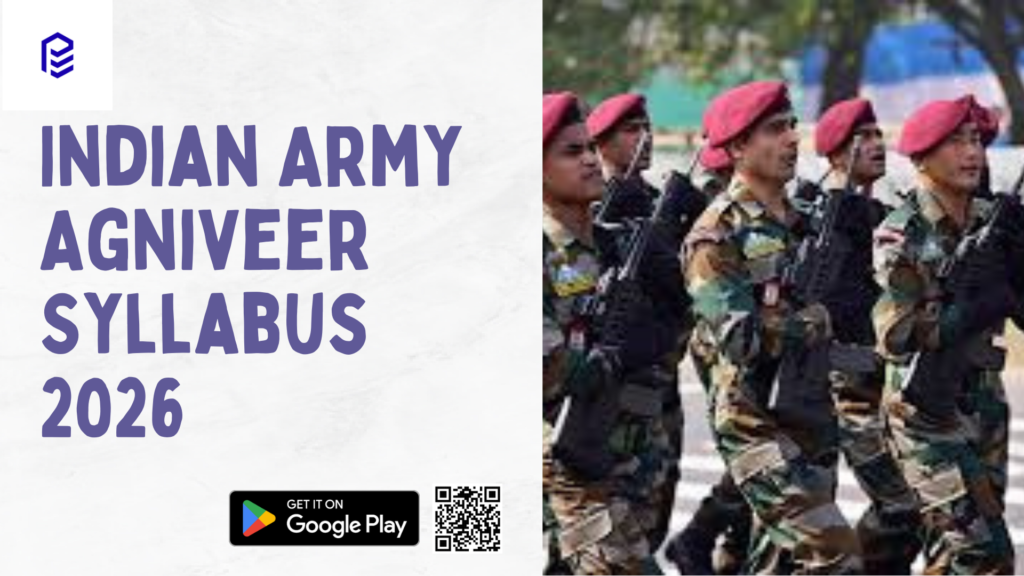
Indian Army Agniveer Syllabus & Exam Pattern 2026

Indian Army Agniveer Syllabus & Exam Pattern 2026

Are you aspiring to join the Indian Army as an Agniveer? Understanding the comprehensive syllabus and exam pattern is your first step toward success. The Indian Army Agniveer recruitment scheme, also known as Agnipath, offers a unique opportunity for young Indians to serve the nation. This detailed guide covers everything you need to know about the Agniveer syllabus 2026, exam pattern, physical fitness requirements, and selection process.

In this comprehensive article, we’ll break down the complete syllabus for all Agniveer posts including Soldier Clerk, Soldier General Duty (GD), Soldier Technical, and Soldier Tradesman. Whether you’re just starting your preparation or looking for detailed topic-wise coverage, this guide will help you navigate the Indian Army Agniveer recruitment process with confidence.

1. About Indian Army Agniveer Scheme

The Agniveer scheme, officially known as Agnipath, is a transformative recruitment initiative launched by the Indian Armed Forces to induct young, energetic, and motivated individuals into the Army, Navy, and Air Force. Under this scheme, recruits serve for a period of four years, with opportunities for permanent retention based on performance.

Key Features of Agniveer Scheme:

  • Service Duration: 4 years with the possibility of permanent retention for 25% of each batch
  • Age Limit: 17.5 to 21 years (relaxation for certain categories)
  • Salary Package: Starting from ₹30,000 per month in the first year, increasing annually
  • Seva Nidhi Package: ₹11-12 lakhs after 4 years of service (for non-retained personnel)
  • Educational Benefits: Certificate and skill training for post-service employment
  • Posts Available: Soldier Clerk, Soldier GD, Soldier Technical, Soldier Tradesman, and more

2. Indian Army Agniveer Selection Process 2026

The selection process for Indian Army Agniveer recruitment is comprehensive and multi-staged, designed to assess candidates on academic knowledge, physical fitness, and medical standards. Understanding each stage is crucial for effective preparation.

Three-Stage Selection Process:

Stage 1: Common Entrance Exam (CEE) – Written Test

The Common Entrance Exam is a computer-based test that evaluates candidates on various subjects depending on their chosen post. This is the first and most crucial screening stage.

CEE Test Format:

  • Multiple Choice Questions (MCQs)
  • Online/Computer-Based Test
  • Negative marking applicable for some posts
  • Subjects: General Knowledge, Mathematics, General Science, English, Computer Science (post-specific)
  • Duration: 1-2 hours depending on the post

Stage 2: Physical Fitness Test (PFT) – Rally Test

Only candidates who clear the written exam are called for the Physical Fitness Test at designated rally sites across India. This test evaluates your physical strength, endurance, and agility.

PFT Components:

  • 1.6 km Running Test (60 marks maximum)
  • Pull-ups/Beam Test (40 marks maximum)
  • Height and Chest Measurement
  • Total Physical Marks: 100

Stage 3: Medical Examination

Candidates who successfully complete the physical tests undergo a thorough medical examination at designated Military Hospitals to ensure they meet the Indian Army’s health standards.

Medical Standards Include:

  • Blood tests (Hemoglobin, Blood Sugar, etc.)
  • X-Ray and ECG
  • Vision and hearing tests
  • General physical examination
  • Drug screening tests

3. Common Entrance Exam (CEE) Pattern 2026

The CEE exam pattern varies based on the post you’re applying for. Here’s a detailed breakdown of the exam structure for different Agniveer positions.

Soldier Clerk Exam Pattern

AspectDetailsRemarks
Total Questions50 or 100Based on category
Duration1 or 2 hoursPost-specific
Negative MarkingYes25% deduction per wrong answer
SubjectsGK, GS, Maths, English, ComputerAll subjects mandatory
Exam ModeComputer-Based Test (CBT)Online mode

Soldier GD Exam Pattern

SubjectQuestionsMarksWeightage
General Knowledge153030%
General Science153030%
Mathematics153030%
Logical Reasoning51010%
Total50100100%

Pass Marks: 35 out of 100 (NCC ‘C’ Certificate holders are exempted from written exam)

Soldier Technical Exam Pattern

SubjectQuestionsMax. Marks
General Knowledge1040
Mathematics1560
Physics1560
Chemistry1040
Total50200

Marking Scheme:

  • Each correct answer: +4 marks
  • Each incorrect answer: -1 mark (Negative Marking)
  • Passing marks: 80 out of 200

4. Soldier Clerk Syllabus 2026 (Detailed)

The Soldier Clerk position is one of the most sought-after roles in the Indian Army Agniveer recruitment. This role involves administrative duties, office management, and clerical work. The syllabus is comprehensive and covers five main subjects.

Subject 1: General Knowledge (GK)

General Knowledge is crucial for Soldier Clerk and covers a wide range of topics from current affairs to Indian history, geography, and more.

TopicWhat to Study
AbbreviationsNational and International abbreviations including government bodies (ISRO, DRDO, UNO, NATO), organizations (WHO, UNESCO, UNICEF), and commonly used short forms
Sports & GamesNational and International sports events (Olympics, Asian Games, Commonwealth Games), tournaments (IPL, FIFA World Cup, Wimbledon), current champions, famous Indian and international athletes
Awards & HonorsNational awards (Bharat Ratna, Padma Awards), Gallantry awards (Param Vir Chakra, Maha Vir Chakra, Ashok Chakra), Nobel Prizes (winners and categories), recent award recipients
Indian HistoryImportant dates and battles (1857 Revolt, Battle of Plassey, Panipat battles), Freedom struggle (leaders, movements, important events), Ancient, Medieval and Modern Indian history landmarks
World HistoryMajor world wars, significant revolutions, important historical figures, formation of nations, major historical events and their dates
GeographySolar System and space exploration (planets, satellites, space missions), Earth’s principal peaks (Himalayas, mountain ranges), Major deserts (Sahara, Thar, Gobi), Important rivers, lakes and waterfalls worldwide, Indian States, capitals and UTs, Geographical superlatives (tallest, longest, biggest)
TerminologyGeographical terms (latitude, longitude, equator, tropics), Economic terms (GDP, inflation, fiscal policy, monetary policy), Astronomical terms (galaxy, constellation, meteor), Legal terms (Constitution, judiciary, fundamental rights), Miscellaneous scientific and technical terms
Countries & CurrenciesAll major countries and their currencies, capital cities, neighboring countries of India, G7, G20, BRICS nations
Current AffairsLast 6 months current events, Important national and international news, Government schemes and initiatives, Economic developments, Banking sector updates, Important appointments and resignations
Indian ConstitutionFundamental Rights and Duties, Directive Principles, Structure of government, Important articles, Amendments, Constitutional bodies

Subject 2: General Science

General Science covers Physics, Chemistry, and Biology fundamentals based on Class 8th to 12th curriculum, with focus on day-to-day applications.

TopicDetailed Coverage
Human BodyAll body systems (Digestive, Respiratory, Circulatory, Nervous, Excretory, Reproductive), Organs and their functions, Bones and muscles, Blood groups and circulation, Brain and nervous system
Food & NutritionBalanced diet components, Carbohydrates, proteins, fats, vitamins and minerals, Calorie requirements, Nutritional deficiency diseases (Kwashiorkor, Marasmus, Anemia), Food preservation methods
Diseases & PreventionCommunicable diseases (Tuberculosis, Malaria, Dengue, COVID-19, Cholera), Non-communicable diseases (Diabetes, Hypertension, Cancer), Disease-causing organisms, Prevention methods, Vaccines and immunization
Vitamins & MineralsAll vitamins (A, B-complex, C, D, E, K) with sources and functions, Deficiency diseases (Scurvy, Rickets, Night blindness, Beriberi), Essential minerals (Iron, Calcium, Iodine, Zinc)
Physics FundamentalsMotion and force (Newton’s Laws), Energy forms and conservation, Electricity and magnetism, Light (Reflection, Refraction), Sound waves, Heat and temperature, Simple machines
Chemistry FundamentalsAtoms and molecules, Elements, compounds and mixtures, Periodic table basics, Chemical reactions and equations, Acids, bases and salts, Metals and non-metals
Biology FundamentalsCell structure and functions, Photosynthesis and respiration in plants, Human physiology, Genetics and heredity, Evolution, Ecology and ecosystem, Biodiversity

Subject 3: Mathematics

TopicSub-topics & Formulas
AlgebraAlgebraic expressions operations, HCF and LCM, Factorization, Simple equations, Surds, Indices, Logarithms, Linear equations in two/three variables, Quadratic equations (ax² + bx + c = 0)
ArithmeticNumber System, Decimal fractions, HCF & LCM, Square roots, Ratio and Proportion, Percentages, Averages, Profit & Loss, Simple and Compound Interest
MensurationArea and Perimeter of 2D shapes, Area of four walls, Circle sector and segment, Surface area and volume of cube, cuboid, cone, cylinder, sphere
TrigonometryTrigonometric ratios (Sin, Cos, Tan), Standard angles, Trigonometric identities, Applications in solving right triangles
GeometryLines and Angles, Triangles (Congruence, Similarity, Pythagoras theorem), Quadrilaterals, Circles (Chord, Tangent, Secant properties)
StatisticsData organization, Frequency distribution, Histograms, Frequency polygons, Mean, Median, Mode (grouped and ungrouped data)

Subject 4: General English

TopicWhat to Prepare
Parts of SpeechArticles (A, An, The), Nouns, Pronouns, Adjectives, Prepositions, Conjunctions, Modals (Can, Could, May, Might, Must, Should, Would)
Verbs & TensesAll 12 tenses (Present, Past, Future – Simple, Continuous, Perfect, Perfect Continuous), Active and Passive Voice, Subject-Verb Agreement
Sentence StructureTypes of Sentences, Affirmative/Negative sentences, Question formation, Direct and Indirect Speech, Clauses and Phrases
VocabularyIdioms and Phrases, Synonyms, Antonyms, One Word Substitution, Homophones, Commonly Confused Words

Subject 5: Computer Science

TopicDetailed Syllabus
Computer BasicsComputer characteristics, Components (CPU, VDU, Keyboard), Memory (RAM, ROM, Primary, Secondary), Units (Byte, KB, MB, GB, TB)
Input/Output DevicesMouse, Keyboard, Joystick, Scanner, Microphone, OCR, MICR, Light pen, Barcode Reader, Digital Camera, Printer, Speaker, Plotter
MS-WindowsOperating System basics, Desktop, My Computer, Recycle Bin, Windows Explorer, File/Folder management, Creating Shortcuts, Accessories (Notepad, Paint, Calculator, WordPad)
MS-WordCreating documents, Editing (Cut, Copy, Paste), Formatting (Bold, Italic, Underline, Font, Size, Color, Alignment), Headers/Footers, Page numbering, Tables, WordArt, Clipart, Print Preview
MS-PowerPointPresentation basics, Slide Layouts, Creating presentations, Different views (Normal, Slide Sorter, Slide Show), Adding text, images, Formatting slides, Transitions
MS-ExcelSpreadsheet basics, Worksheets and Workbooks, Entering data, Cell formatting, Formulas (SUM, AVERAGE, MAX, MIN, COUNT), Rows/Columns operations

💡 Pro Tip for Soldier Clerk: Computer Science and English are your differentiating subjects. Practice MS Office applications hands-on for better understanding!

5. Soldier GD (General Duty) Syllabus 2026

Soldier General Duty is the backbone of the Indian Army, responsible for combat operations, border patrolling, security duties, and various operational tasks. The Soldier GD syllabus is designed to test basic knowledge across key subjects.

Complete Subject-wise Syllabus

1. General Knowledge (15 Questions = 30 Marks)

TopicCoverageImportance
Current AffairsLast 6 months events, Government schemes, Sports, Awards⭐⭐⭐⭐⭐
Indian HistoryFreedom struggle, Battles, National movement⭐⭐⭐⭐
GeographyIndian & World geography, States, Rivers, Mountains⭐⭐⭐⭐
Indian PolityConstitution, Fundamental Rights, Government structure⭐⭐⭐
SportsTournaments, Players, Recent events, Olympics⭐⭐⭐⭐
Science & TechnologyISRO missions, Defense tech, Digital India⭐⭐⭐⭐

2. General Science (15 Questions = 30 Marks)

Physics Topics:

  • Motion, Force, and Energy
  • Light and Sound
  • Electricity and Magnetism
  • Heat and Temperature
  • Simple Machines

Chemistry Topics:

  • Matter and its states
  • Elements, Compounds, Mixtures
  • Acids, Bases, and Salts
  • Chemical Reactions
  • Metals and Non-metals

Biology Topics:

  • Human Body Systems
  • Diseases and Health
  • Food and Nutrition
  • Plants and Photosynthesis
  • Cell Structure

3. Mathematics (15 Questions = 30 Marks)

TopicKey Concepts
ArithmeticNumbers, Fractions, Decimals, HCF, LCM, Square roots, Percentage, Ratio, Average, Profit & Loss, Simple Interest
AlgebraBasic operations, Factorization, Linear equations, Quadratic equations
GeometryLines, Angles, Triangles, Quadrilaterals, Circles, Properties and theorems
MensurationArea and Perimeter of 2D shapes, Volume and Surface area of 3D shapes

4. Logical Reasoning (5 Questions = 10 Marks)

  • Series Completion: Number series, Letter series, Alpha-numeric series
  • Coding-Decoding: Letter coding, Number coding, Substitution
  • Analogies: Number, Letter, Word analogies
  • Blood Relations: Family tree problems
  • Direction Sense: Distance and direction questions
  • Odd One Out: Finding the different element

🎯 Soldier GD Strategy: Mathematics and General Knowledge carry equal weightage. Balance your preparation between these subjects. Don’t ignore the 5 reasoning questions!

6. Soldier Technical Syllabus 2026

Soldier Technical positions are for candidates with strong aptitude in Science and Mathematics. These roles involve maintaining and operating technical equipment, vehicles, and weapons systems.

Eligibility Requirements

  • Educational Qualification: 10+2 with Physics, Chemistry, Mathematics
  • Minimum Percentage: 50% aggregate in PCM
  • Age: 17.5 to 23 years

Subject-wise Detailed Syllabus

Mathematics (15 Questions = 60 Marks)

Advanced Topics (10+2 Level):

  1. Algebra: Quadratic equations, Progressions (AP, GP, HP), Binomial theorem, Permutations and combinations
  2. Calculus: Limits, Differentiation, Integration, Applications of derivatives
  3. Coordinate Geometry: Straight lines, Circles, Parabola, Ellipse, Hyperbola
  4. Trigonometry: Functions and identities, Inverse functions, Heights and distances
  5. Vectors: Vector algebra, Scalar and vector products
  6. Probability: Basics, Conditional probability, Bayes theorem
  7. Matrices: Types, Operations, Determinants

Physics (15 Questions = 60 Marks)

UnitTopics Covered
MechanicsMotion in straight line, Laws of motion, Work energy power, Gravitation, Properties of solids and liquids
ThermodynamicsHeat and temperature, Thermal expansion, Calorimetry, Heat transfer, Laws of thermodynamics
ElectricityElectric charge and field, Current electricity, Resistance, Kirchhoff’s laws, Heating effects
MagnetismMagnetic effects of current, Electromagnetic induction, Alternating current
OpticsReflection, Refraction, Lenses, Optical instruments, Wave optics
Modern PhysicsDual nature of matter, Atoms and nuclei, Semiconductor electronics, Nuclear energy

Chemistry (10 Questions = 40 Marks)

Physical Chemistry:

  • Atomic structure and chemical bonding
  • States of matter
  • Chemical thermodynamics
  • Chemical equilibrium
  • Electrochemistry and redox reactions

Inorganic Chemistry:

  • Periodic table and periodicity
  • s-block elements (Alkali and Alkaline earth metals)
  • p-block elements
  • d-block and f-block elements
  • Metallurgy and extraction of metals

Organic Chemistry:

  • Hydrocarbons (Alkanes, Alkenes, Alkynes, Aromatic)
  • Organic compounds containing halogens
  • Alcohols, phenols, and ethers
  • Aldehydes, ketones, and carboxylic acids
  • Polymers and biomolecules

⚠️ Important: Negative marking of 1 mark per wrong answer. Only attempt questions you’re confident about. Passing marks is 40% (80/200)!

7. Physical Fitness Test – Complete Standards

The Physical Fitness Test is conducted at rally sites for candidates who clear the written exam. This test carries 100 marks.

1.6 Km Running Test (60 Marks)

GroupTimeMarks
Group IUp to 5 min 30 sec60
Group II5 min 31 sec to 5 min 45 sec48

Training Tips for 1.6 Km Run:

  1. Build Stamina Gradually: Start with 800m, increase to 2 km
  2. Interval Training: Mix sprinting and jogging
  3. Proper Breathing: Inhale through nose, exhale through mouth
  4. Morning Runs: Best time is early morning
  5. Weekly Target: Reduce time by 5-10 seconds each week
  6. Rest Days: Take 1-2 rest days per week

Pull-ups Test (40 Marks)

Pull-upsMarksLevel
1040Outstanding
933Excellent
827Very Good
721Good
616Satisfactory

How to Increase Pull-ups:

  1. Grip Strength: Hang from bar daily, increase duration
  2. Assisted Pull-ups: Use resistance bands
  3. Negative Pull-ups: Start from top, slowly lower
  4. Alternative Exercises: Lat pulldowns, Rows, Bicep curls
  5. Proper Form: Full extension at bottom, chin above bar
  6. Daily Practice: Maximum pull-ups 3 times a day

Height & Chest Requirements

CategoryHeightChest (Unexpanded)Chest (Expanded)
General170 cm77 cm82 cm
Hilly Regions165 cm77 cm82 cm
North-East States162.5 cm77 cm82 cm

Note: Minimum chest expansion required is 5 cm. Weight should be proportionate to height.

8. Medical Examination Details

Candidates must report to designated Military Hospital within 5 days. Medical examination must be completed within 14 days.

Complete Medical Tests

Blood Tests:

  • Blood Haemogram (Hb, TLC, DLC)
  • Blood Sugar (Fasting and Post Prandial)
  • Serum Cholesterol
  • Blood Urea, Uric Acid, Creatinine
  • Liver Function Tests (Bilirubin, SGOT, SGPT)

Other Tests:

  • Urine Examination (RE/ME)
  • X-Ray Chest (PA view)
  • ECG (Electrocardiogram)
  • Drug Screening Tests
  • Vision and Hearing Tests

Common Medical Disqualifications

CategoryGrounds for Rejection
VisionSevere myopia, Squint, Color blindness, Night blindness
PhysicalFlat feet, Knock knees, Bow legs, Varicose veins, Hernia
Chronic DiseasesAsthma, Tuberculosis, Diabetes, Epilepsy, Heart disease
DentalLess than 14 dental points, Severe gum disease

Tips for Medical Clearance

  1. Maintain healthy lifestyle: Balanced diet, regular exercise, adequate sleep
  2. Avoid bad habits: No smoking, alcohol, or drugs
  3. Dental care: Regular brushing, flossing, dental check-ups
  4. Eye care: Reduce screen time, proper lighting
  5. Stay hydrated: Drink adequate water daily
  6. Pre-medical checkup: Get tested beforehand

9. Preparation Tips & Strategy

6-Month Preparation Plan

MonthFocus AreasTarget
Month 1-2Complete syllabus coverage, Basic concepts, Start physical trainingCover all subjects, Run 1.6km in 7 mins
Month 3-4Topic-wise practice, Weak area improvement, Increase intensity50% practice done, Run in 6 mins, 5 pull-ups
Month 5Mock tests, Time management, Peak fitness70%+ in mocks, Run in 5:30, 8 pull-ups
Month 6Revision, Previous years, Final prepComplete readiness, Run in 5:20, 10 pull-ups
Indian Army Agniveer Syllabus & Exam Pattern 2026

Subject-wise Preparation Tips

Mathematics

  • Practice daily – minimum 50 questions
  • Create formula sheets for quick revision
  • Focus on speed and accuracy
  • Learn shortcut methods
  • Time yourself while practicing

General Knowledge

  • Read newspaper daily
  • Watch news channels
  • Make monthly current affairs notes
  • Focus on last 6 months events
  • Revise static GK weekly

General Science

  • Understand concepts, don’t memorize
  • Use diagrams and flowcharts
  • Link topics to daily life
  • Watch educational videos
  • Practice MCQs regularly

Best Books & Resources

SubjectRecommended Books
MathematicsR.S. Aggarwal, Rakesh Yadav, Kiran Publication
General KnowledgeLucent’s GK, Manorama Yearbook, Arihant GK
General ScienceLucent’s Science, NCERT (Class 6-10), Arihant
EnglishWren & Martin, S.P. Bakshi, Arihant English
Computer ScienceBasic Computer Knowledge by Arihant

🏆 Success Mantra: Consistency beats intensity. 3 hours of focused daily study for 6 months is better than 10 hours of random study for 2 months!

10. Frequently Asked Questions (FAQs)

Q1: What is the age limit for Agniveer?

Answer: 17.5 to 21 years (relaxation for certain categories)

Q2: Is there negative marking in Agniveer exam?

Answer: Soldier Clerk: Yes (25% deduction), Soldier GD: No, Soldier Technical: Yes (1 mark deduction)

Q3: Are NCC holders exempted?

Answer: Yes, NCC ‘C’ certificate holders are exempted from written exam for Soldier GD

Q4: What is the salary during service?

Answer: 1st year: ₹30,000, 2nd: ₹33,000, 3rd: ₹36,500, 4th: ₹40,000 per month

Q5: What happens after 4 years?

Answer: 25% retained in regular service, 75% receive Seva Nidhi of ₹11-12 lakhs with certificate

Final Words

Ready to Begin Your Journey?

The Indian Army is waiting for dedicated youngsters like you. Start your preparation today, stay committed to your goal, and remember – every Agniveer who wears the uniform started exactly where you are now.

JAI HIND! 🇮🇳

Your dream of serving in the Indian Army is just preparation away. Start today, stay dedicated, and success will be yours!

Bihar Police BPSSC SI Prohibition Exam Syllabus & Pattern 2026 — Complete Guide

The Bihar Police Subordinate Services Commission (BPSSC) conducts the Sub‑Inspector (SI) Prohibition exam as part of its recruitment process for eligible candidates. Along with meeting the eligibility criteria, understanding the syllabus and exam pattern is crucial for strategic preparation and success in the competitive exam. This article breaks down the exam stages, marking scheme, subjects, and topic‑wise syllabus to help you prepare with clarity.

Overview of Exam Stages

The BPSSC SI Prohibition selection process includes three major stages:

  1. Preliminary Examination (Prelims)
  2. Main Written Examination (Mains)
  3. Physical Efficiency/Standard Test (PET/PST)

Candidates must clear each written stage to qualify for the next round.

BPSSC SI Prohibition Exam Pattern 2026

Understanding the structure of the exam helps candidates plan their preparation schedule more effectively. The exam pattern is divided into Prelims and Mains.

Preliminary Exam Pattern

ComponentDetails
SubjectGeneral Knowledge & Contemporary Issues
TypeObjective (Multiple Choice Questions)
Questions100
Marks200
Exam Duration2 Hours (120 minutes)
Negative MarkingYes (Approximately 0.2 marks per wrong answer)
Qualifying StatusMinimum 30% required to qualify

Note: Scores in Prelims are used only to shortlist candidates for the Mains exam.

Main Written Examination Pattern

The Mains stage consists of two papers:

PaperSubjectQuestionsTotal MarksDuration
Paper‑IGeneral Hindi1002002 Hours
Paper‑IIGeneral Studies & Other Subjects1002002 Hours

🔹 Paper‑I (General Hindi) is qualifying in nature — meaning you must score the minimum required marks (generally 30%) to pass, but its marks are not counted for final ranking.

🔹 Paper‑II is used for final merit list calculation.

Detailed Syllabus Breakdown

Below is a subject‑wise breakdown of the topics covered in both Prelims and Mains stages of the BPSSC SI Prohibition examination.

Prelims Syllabus

The Prelims exam focuses on General Knowledge & Contemporary Issues, including:

  • National & International Current Affairs
  • General Awareness
  • Sports & Awards
  • Important Facts and Figures
  • Renowned Personalities
  • Full Forms & Abbreviations
  • History & Culture
  • Geography (Basic concepts)
  • Economics & Politics (General)
  • Scientific and Technological Updates

This stage tests your awareness of real‑world events and basic general knowledge, which is essential for building a strong foundation for the Mains exam.

Mains Exam Syllabus

The Mains exam has two papers:


Paper‑I – General Hindi

This paper assesses language skills and understanding of Hindi grammar. Major topic areas include:

  • Reading Comprehension
  • Fill in the Blanks
  • Sentence Correction
  • Cloze Test
  • Grammar topics:
    • Sandhi, Samas
    • Synonyms & Antonyms
    • Gender & Number
    • Karak & Vibhakti
    • Pronoun & Verb usage
    • Word Formation
    • Idioms & Phrases

These topics evaluate your command over Hindi writing and grammar.

Paper‑II – General Studies & Other Subjects

This paper covers a broader range of subjects, including:

General Studies & General Science
  • Basic physical and life sciences
  • Motion, force, energy
  • Structures of the atom and molecules
  • Acids, bases, salts
  • Light & sound
  • Pollution and environment
  • Natural resources and phenomena
Mathematics & Mental Ability
  • Number system and basic arithmetic operations
  • Ratio & proportion
  • Profit & Loss, Discount
  • Percentage, Average
  • Data Interpretation
  • Algebra & Puzzles
  • Figure Series, Odd One Out
  • Syllogism, Analogies
  • Blood relations
Civics & Indian Polity
  • Constitution basics
  • Central and state government roles
  • Judiciary and law enforcement
  • Social justice and media understanding
Indian History & Culture
  • Revolt of 1857 and freedom movement
  • Sultans of Delhi and kingdom histories
  • Culture and science contributions
  • India after independence
Indian Geography
  • Earth in the solar system
  • Human environment
  • Natural resources and agriculture
  • Political maps of India
  • Air and water systems

This combined syllabus ensures candidates have a solid grasp of multiple subjects essential for policing and law enforcement roles.

Preparation Tips for BPSSC Prohibition SI

While preparing for the exam pattern and syllabus:

  • Focus on current affairs and general awareness every day.
  • Practice Hindi grammar exercises and comprehension passages.
  • Solve previous year MCQs to understand question types.
  • Take mock tests to improve time management.
  • Revise basic mathematics and reasoning regularly.

Important Notes

  • The Preliminary exam qualifying marks are typically required to be at least 30%. Candidates scoring below this may not be allowed to appear in the Main written exam.
  • Paper‑I of Mains (General Hindi) is qualifying and does not directly affect the final merit list.
  • Paper‑II (General Studies) determines the final ranking for selection.

Conclusion

The BPSSC SI Prohibition exam 2026 demands a strategic preparation plan. By understanding the syllabus and exam pattern thoroughly — from Prelims to Mains — candidates can approach their studies with confidence and clarity. Whether you’re revising current affairs, practicing Hindi grammar, or working on reasoning and general science, every topic has its significance. Start early, maintain consistency, and use mock tests to sharpen your performance before the exam day.