UP Anganwadi Bharti Recruitment 2026

UP Anganwadi Bharti 2026: Complete Guide to Apply Online for 413+ Vacancies

The Uttar Pradesh Government (UP Govt) has officially announced the UP Anganwadi Bharti Recruitment 2026, offering a golden opportunity for women candidates across the state to secure a government job. With 413+ vacancies for Anganwadi Worker and Helper posts spread across dozens of districts, this recruitment is one of the most accessible and significant government job drives for candidates who have passed their Class 12th (Intermediate) examination.

Applications began in November 2025 and are ongoing on a district-wise basis, with last dates varying for each district, extending up to March 2026. This article covers everything you need to know — from eligibility criteria and age limits to the district-wise vacancy breakdown and step-by-step application process.
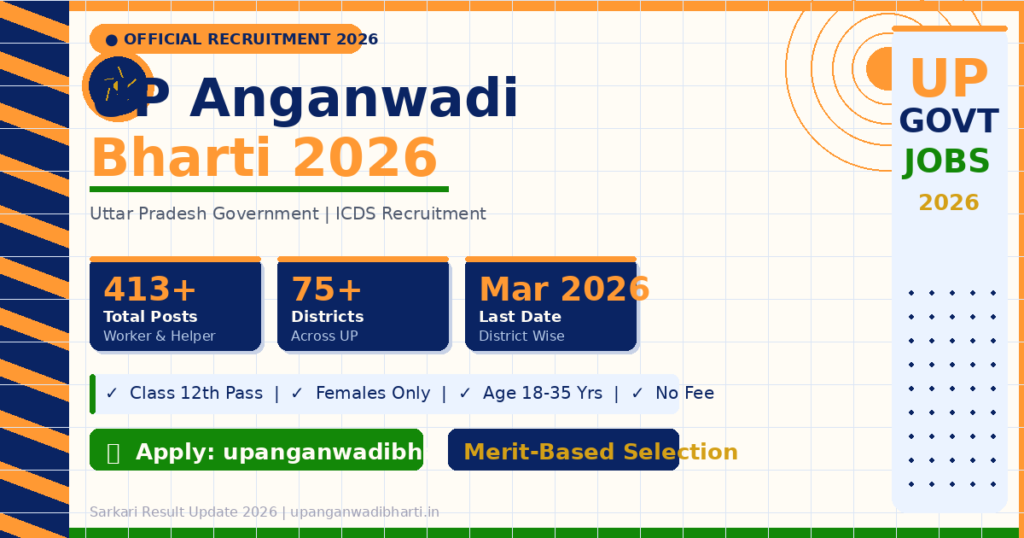
UP Anganwadi Bharti Recruitment 2026, Up ANganwadi Bharti,

What Is UP Anganwadi Bharti 2026?

The Uttar Pradesh Integrated Child Development Services (ICDS) scheme runs thousands of Anganwadi centers across the state to deliver nutrition, health, and education services to children under 6 and pregnant or lactating mothers. To staff these centers, the UP government regularly issues recruitment notifications for two key roles:

  • Anganwadi Worker (Karyakarta) — manages day-to-day operations of the Anganwadi center
  • Anganwadi Helper (Sahayika) — assists the worker in daily activities at the center

Both posts are ideal for local women who wish to serve their communities while securing stable government employment with a monthly honorarium.

UP Anganwadi Bharti 2026: Important Dates

EventDate
Notification ReleasedNovember 2025
Application Start DateNovember 2025
Last Date to ApplyDistrict-Wise (Up to March 2026)
Application ModeOnline

Note: Since the last date is district-specific, candidates must check the notification for their respective district carefully. Several districts have already passed their deadlines — act quickly if your district’s deadline is approaching.

UP Anganwadi Bharti 2026: Application Fee

One of the best aspects of this recruitment is that there is absolutely no application fee. Candidates from all categories — General, OBC, SC, ST — can apply completely free of cost.

UP Anganwadi Bharti 2026: Age Limit

Age CriteriaDetails
Age Calculated As On01 July 2025
Minimum Age18 Years
Maximum Age35 Years
Age RelaxationAs per UP Govt Anganwadi Recruitment Rules

Age relaxation is applicable for reserved category candidates (SC/ST/OBC/PwD) as per the UP Government’s official rules. Candidates are advised to use an online age calculator tool and verify against the official notification.

UP Anganwadi Bharti 2026: Eligibility Criteria

Before applying, every candidate must ensure they meet the following eligibility requirements:

Educational Qualification: Candidates must have passed their Class 12th (10+2 / Intermediate) examination from any recognized board or university in India.

Gender: This recruitment is exclusively for female candidates only.

Domicile Requirement: This is a crucial criterion — the candidate must be a permanent resident of the same Village, Ward, or Nyaya Panchayat from which she is applying. Candidates applying from a different area will not be eligible.

Nationality: Indian citizens only.

Candidates are strongly advised to read the official district-wise notification completely before filling out the application form to ensure they meet all eligibility conditions.

UP Anganwadi Bharti 2026: District-Wise Vacancy Details

The recruitment covers both Anganwadi Worker and Helper posts across multiple districts. Below is a comprehensive district-wise breakdown of vacancies and their respective last dates:

Active / Upcoming Deadlines (As of February 2026)

DistrictPost TypeVacanciesLast Date
SaharanpurWorker2304 March 2026
MirzapurWorker15927 Feb 2026
BalliaWorker1327 Feb 2026
ChitrakootWorker8622 Feb 2026
JalaunWorker0621 Feb 2026
FatehpurWorker2521 Feb 2026
UnnaoWorker2719 Feb 2026
MuzaffarnagarWorker7419 Feb 2026
LucknowWorker7111 Feb 2026
JaunpurWorker0809 Feb 2026

Recently Closed (January – Early February 2026)

DistrictPost TypeVacanciesLast Date
FirozabadWorker20202 Feb 2026
KushinagarWorker2731 Jan 2026
GhazipurHelper1,35218 Jan 2026
AzamgarhWorker1215 Jan 2026
EtahWorker1813 Jan 2026
AligarhWorker2312 Jan 2026
Kanpur NagarWorker3208 Jan 2026
Rae BareliHelper1,03404 Jan 2026
BudaunHelper + Worker1,38204 Jan 2026
KashganjHelper + Worker1,03230 Dec 2025
AyodhyaHelper + Worker94829 Dec 2025
MeerutWorker8422 Dec 2025
AmethiHelper1,02721 Dec 2025
FirozabadHelper96416 Dec 2025
MathuraWorker9814 Dec 2025

Largest vacancies include: Azamgarh Helper (1,554), Ballia Helper (1,365), Ghazipur Helper (1,352), Sitapur Helper (1,408), Lakhimpur Kheri Helper (1,407), and Bahraich Helper (1,316).

The total number of posts advertised across all districts runs into the tens of thousands when Helper posts are counted — making this one of the biggest UP government recruitment drives in recent years.

UP Anganwadi Bharti 2026: Selection Process

The selection process for UP Anganwadi Bharti 2026 is merit-based. There is no written examination or interview. Candidates will be shortlisted based on a Merit List prepared from their educational qualifications and other criteria as defined in the district-specific notification.

This means:

  • Higher academic marks improve your chances of selection
  • No exam preparation is needed — just ensure all documents are in order
  • The merit list will be published by the respective district authorities

UP Anganwadi Bharti 2026: How to Apply Online

Applying for UP Anganwadi Bharti 2026 is a straightforward online process. Follow these steps:

Step 1: Visit the official UP Anganwadi Bharti portal at upanganwadibharti.in.

Step 2: Click on the “Register” link to create a new account with your mobile number and basic details.

Step 3: After registration, log in using your credentials.

Step 4: Select your district and the relevant post (Worker or Helper).

Step 5: Fill in the application form carefully with your personal details, educational qualifications, and residential address.

Step 6: Upload the required documents (photo, signature, educational certificates, residence proof, etc.) in the specified format and size.

Step 7: Review the form thoroughly before final submission.

Step 8: Submit the form and download or print the confirmation/acknowledgement for future reference.

Important: Always read the official district-wise notification before filling out the form. Pay special attention to the residential eligibility requirement — candidates must belong to the same ward/village/Nyaya Panchayat from which they are applying.

Key Documents Required

While specific requirements may vary by district, the following documents are generally needed:

  • Class 12th Marksheet and Certificate
  • Domicile/Residence Certificate (of the specific Village/Ward/Nyaya Panchayat)
  • Caste Certificate (if applicable, for age relaxation)
  • Aadhaar Card
  • Recent Passport-size Photograph
  • Signature
  • Mobile Number (linked to Aadhaar preferred)

Why You Should Apply for UP Anganwadi Bharti 2026

  1. No Application Fee: Zero cost to apply — accessible to all eligible womens.
  2. No Written Exam: Selection is purely merit-based, saving preparation time and stress.
  3. Local Posting: Anganwadi workers and helpers serve in their own village or ward, eliminating the burden of relocation.
  4. Stable Government Employment: Monthly honorarium provided by the UP government with potential for periodic revision.
  5. Social Impact: The role directly contributes to the health, nutrition, and education of young children and mothers in the community.
  6. Low Entry Barrier: Only a Class 12th pass is required — making it inclusive for a wide range of women candidates.

Frequently Asked Questions (FAQs)

Q: When did online applications open for UP Anganwadi Bharti 2026? A: Online applications started in November 2025 and are ongoing on a district-wise basis.

Q: What is the last date to apply for UP Anganwadi Bharti 2026? A: The last date varies by district. Deadlines range from late 2025 through March 2026. Check your specific district’s notification for the exact date.

Q: What is the minimum qualification required? A: Candidates must have passed the Class 12th (10+2 / Intermediate) examination from a recognized board.

Q: Can male candidates apply for UP Anganwadi Bharti 2026? A: No. This recruitment is exclusively for female candidates only.

Q: Is there any application fee? A: No. There is absolutely no application fee for this recruitment.

Q: What is the age limit for UP Anganwadi Bharti 2026? A: The minimum age is 18 years and the maximum age is 35 years, as of 01 July 2025. Age relaxation is available as per UP government rules.

Q: What is the selection process? A: Selection is based entirely on a Merit List — no written exam or interview.

Q: Where do I apply? A: Visit the official website at upanganwadibharti.in to register and apply online.

Q: How can I check my result or merit list? A: Once released, the merit list/result can be downloaded from the official UP Anganwadi Bharti website using your registration number or roll number.

Final Words

The UP Anganwadi Bharti 2026 is a landmark recruitment opportunity for women across Uttar Pradesh seeking stable, meaningful government employment close to home. With no application fee, no written examination, and eligibility for anyone who has passed Class 12th, this is one of the most accessible government jobs available in the state today.

If your district’s deadline is still open, do not delay — apply immediately at upanganwadibharti.in. Read the official notification for your district carefully, ensure your residential eligibility, gather your documents, and submit your application before the closing date.

For the latest updates, admit cards, merit lists, and results related to UP Anganwadi Bharti 2026, bookmark this page and check back regularly.

Disclaimer: All information in this article is based on the official notification published by the Uttar Pradesh Government. Candidates are advised to verify all details from the official website before applying. This article is for informational purposes only.
India’s AI Impact Summit and the Rise of Technological Diplomacy

India’s hosting of the AI Impact Summit under the leadership of Prime Minister Narendra Modi marks a defining step in the country’s ambition to position itself as a global leader in artificial intelligence and digital governance. In an era where technology increasingly shapes economic power, geopolitical influence and national security, artificial intelligence has emerged as a strategic frontier. For aspirants preparing for UPSC, SSC and other competitive examinations, the AI Impact Summit represents a contemporary case study at the intersection of economy, international relations, innovation policy and global governance.

Artificial intelligence is no longer confined to research laboratories or niche industrial applications. It is transforming sectors ranging from healthcare and education to defense, agriculture and financial services. AI-driven analytics enable predictive healthcare diagnostics, precision farming, intelligent transportation systems and automated financial compliance. Countries that lead in AI innovation gain competitive advantages in productivity, military capability and digital infrastructure. Recognizing this transformative potential, India has intensified its efforts to build a comprehensive AI ecosystem.

The AI Impact Summit reflects India’s strategic objective of fostering collaboration between governments, private industry, startups and academic institutions. By convening global stakeholders, India seeks to shape international norms around ethical AI, data governance and responsible innovation. This approach demonstrates the emergence of technological diplomacy as a new dimension of foreign policy. Just as energy security and trade negotiations shaped earlier diplomatic agendas, AI governance is now becoming central to global discourse.

Economic Significance of AI for India

From an economic perspective, AI has the potential to significantly boost India’s GDP growth. According to various economic estimates, AI-driven automation and data analytics could add billions of dollars to India’s economy in the coming decade. Enhanced productivity, cost efficiency and innovation capacity will drive this transformation. Sectors such as fintech, e-commerce, logistics and manufacturing stand to benefit immensely from AI integration.

India’s demographic advantage also plays a crucial role. With a large pool of engineers, software developers and data scientists, the country possesses strong human capital to support AI expansion. Initiatives such as Digital India and the national semiconductor mission complement AI growth by strengthening digital infrastructure and hardware capabilities. The AI Impact Summit signals India’s readiness to move beyond being merely a service provider to becoming a global innovation hub.

Startups form another vital component of this ecosystem. India’s vibrant startup environment, particularly in cities like Bengaluru and Hyderabad, has produced numerous AI-focused enterprises. By providing policy support, funding opportunities and regulatory clarity, the government aims to create an enabling environment for innovation. The summit thus serves as both a diplomatic platform and an economic catalyst.

AI and Global Governance

Artificial intelligence raises complex ethical and regulatory questions. Issues such as algorithmic bias, data privacy, cybersecurity threats and autonomous weapon systems demand coordinated international responses. Unlike traditional technologies, AI systems often operate across borders, making unilateral regulation ineffective. Therefore, global governance frameworks are essential.

India’s participation in shaping these frameworks enhances its diplomatic standing. By advocating principles such as inclusive AI, equitable access and ethical safeguards, India positions itself as a responsible stakeholder in global technology governance. The AI Impact Summit provides a platform to articulate these principles and engage with major powers, multilateral organizations and technology corporations.

Technological diplomacy also intersects with strategic competition. The United States, China and the European Union are heavily investing in AI leadership. India must navigate this landscape carefully, maintaining strategic autonomy while forming partnerships that strengthen its technological capabilities. Participation in international AI forums enables India to balance cooperation and competition effectively.

Data Sovereignty and Digital Public Infrastructure

A critical dimension of AI development is data governance. AI systems rely heavily on large datasets for training and optimization. Ensuring that data is used ethically and securely is vital for protecting citizens’ rights. India’s digital public infrastructure model, including Aadhaar-based identification systems and digital payment platforms, has demonstrated how technology can scale rapidly in a large democracy.

The AI Impact Summit reinforces India’s emphasis on responsible data usage and digital sovereignty. By promoting frameworks that respect privacy while enabling innovation, India seeks to create a balanced regulatory environment. Data sovereignty also has geopolitical implications, as countries increasingly assert control over data flows within their territories.

National Security Implications

AI has significant implications for defense and national security. Autonomous systems, predictive surveillance, cyber defense mechanisms and intelligence analytics are transforming modern warfare. For India, situated in a complex regional security environment, strengthening AI capabilities is strategically imperative. The summit thus aligns with broader national security objectives by encouraging research collaborations and technological partnerships.

However, the militarization of AI also raises ethical concerns. International discussions on regulating lethal autonomous weapons and preventing misuse of AI in cyber warfare are gaining momentum. India’s engagement in such dialogues enhances its credibility as a responsible power advocating peaceful and secure technological advancement.

Human Capital and Skill Development

While AI promises economic growth, it also poses challenges related to employment and workforce transition. Automation may displace certain low-skilled jobs, particularly in routine manufacturing or clerical sectors. Therefore, skill development and reskilling programs are essential. India’s focus on STEM education, coding initiatives and digital literacy programs complements its AI ambitions.

The AI Impact Summit provides an opportunity to emphasize inclusive growth strategies. Ensuring that AI benefits reach rural areas, small enterprises and marginalized communities will determine whether technological progress translates into broad-based development. Policymakers must integrate innovation with social equity.

Relevance for Competitive Examinations

For UPSC aspirants, the AI Impact Summit is highly relevant under General Studies Paper III in the context of science and technology, economic development and innovation. It also connects with General Studies Paper II under themes of international relations and global governance. Essay topics such as “Artificial Intelligence and the Future of Work,” “Technological Sovereignty in the 21st Century,” and “Ethics in Emerging Technologies” can draw insights from this development.

Candidates should analyze both opportunities and risks. Opportunities include productivity gains, global leadership and strategic autonomy. Risks involve job displacement, cybersecurity threats and ethical dilemmas. A balanced perspective reflecting economic, diplomatic and governance dimensions is essential.

Conclusion

India’s AI Impact Summit symbolizes the country’s transition into a proactive participant in global technological governance. By integrating economic ambition with diplomatic outreach and ethical considerations, India seeks to harness artificial intelligence as a driver of growth and strategic influence. The leadership of Prime Minister Narendra Modi underscores the political commitment behind this vision.

For competitive examination aspirants, the summit offers a multidimensional case study illustrating how emerging technologies reshape national priorities and international relations. Artificial intelligence is not merely a technological innovation; it is a transformative force influencing economic models, security doctrines and global governance structures. India’s engagement with AI today will significantly shape its developmental trajectory in the decades to come.

Bihar’s Mukhyamantri Mahila Rojgar Yojana and Women-Centric Welfare

The growing emphasis on women-centric welfare policies in India has reshaped the contours of state-led development in recent years. Among notable initiatives, Bihar’s Mukhyamantri Mahila Rojgar Yojana stands out as a significant example of targeted economic empowerment through Direct Benefit Transfer (DBT). The scheme, which provides financial assistance directly into the bank accounts of women beneficiaries, reflects the broader transformation of welfare governance in India. For aspirants of UPSC, SSC and State PCS examinations, this initiative offers a rich case study combining economic policy, fiscal management, gender justice and administrative reforms.

The Mukhyamantri Mahila Rojgar Yojana was introduced by the Government of Bihar with the aim of strengthening women’s participation in economic activities, particularly at the grassroots level. Under the scheme, eligible women receive financial support, often credited directly into their bank accounts, to promote self-employment and small-scale entrepreneurial activities. Reports indicate that lakhs of beneficiaries have received ₹10,000 each under the program, resulting in substantial financial outlays by the state government. The use of DBT ensures transparency and minimizes leakages, which historically plagued welfare distribution systems.

Rise of Direct Benefit Transfers in India

The DBT mechanism represents a structural shift in welfare delivery. Instead of channeling funds through multiple bureaucratic layers, the government transfers money directly into beneficiaries’ bank accounts. This approach gained momentum after the launch of the Jan Dhan-Aadhaar-Mobile (JAM) trinity framework at the national level. By linking bank accounts with Aadhaar identification and mobile numbers, governments have been able to reduce duplication, eliminate ghost beneficiaries and enhance financial inclusion.

In the context of Bihar’s scheme, DBT ensures that funds reach women directly, empowering them with financial autonomy. This model aligns with the broader objective of women-led development emphasized in national policy discourse. Financial empowerment not only enhances household income but also increases women’s decision-making capacity within families and communities.

Economic Rationale Behind Women-Focused Welfare

From an economic perspective, targeted cash transfers to women can produce multiplier effects. Studies have shown that women are more likely to spend additional income on health, education and nutrition, thereby improving human development indicators. By providing seed capital for small enterprises such as tailoring, dairy farming or micro-retail, the scheme aims to generate sustainable income sources rather than temporary consumption benefits.

The scheme also reflects the principle of inclusive growth. In states like Bihar, where female labor force participation remains relatively low, economic empowerment initiatives are critical for expanding productive capacity. Encouraging women’s entrepreneurship contributes to poverty reduction, employment generation and local economic dynamism. When women enter markets as producers rather than mere consumers, they enhance overall economic resilience.

Fiscal Implications and Sustainability

While welfare schemes aimed at women empowerment carry clear social benefits, they also raise questions regarding fiscal sustainability. Large-scale cash transfer programs require significant budgetary allocations. Bihar’s cumulative disbursement under women-focused schemes runs into thousands of crores of rupees. For a state with developmental challenges and limited fiscal space, maintaining long-term sustainability demands careful financial planning.

Public finance theory emphasizes that welfare spending must balance equity and efficiency. Excessive populist measures may strain state finances if not accompanied by revenue growth or economic expansion. Therefore, evaluation of such schemes should consider not only immediate social impact but also long-term fiscal prudence. Monitoring mechanisms, outcome assessments and periodic audits are essential to ensure that funds achieve intended objectives.

Governance and Transparency

One of the most significant advantages of DBT-based schemes is improved governance transparency. By transferring money directly into verified bank accounts, the risk of corruption and middlemen interference is substantially reduced. This approach strengthens public trust in state institutions and enhances accountability.

Furthermore, digital record-keeping enables better data analytics. Governments can track utilization patterns, identify gaps and adjust policy design accordingly. However, digital governance also requires robust cybersecurity frameworks and grievance redressal systems to address issues such as authentication errors or delayed payments.

Social Justice and Gender Empowerment

Women-centric welfare policies are deeply connected with the constitutional vision of social justice. The Indian Constitution under Articles 14, 15 and 16 guarantees equality and prohibits discrimination on the basis of sex. Directive Principles of State Policy further encourage the state to promote social welfare and protect the interests of marginalized groups. Bihar’s scheme can be seen as an attempt to operationalize these constitutional ideals through economic instruments.

Beyond financial assistance, such schemes carry symbolic value. They signal recognition of women as independent economic agents. When women receive money in their own bank accounts, it enhances their visibility in the formal financial system. Financial literacy initiatives accompanying such schemes further expand empowerment outcomes.

However, critics argue that direct cash transfers alone may not address structural barriers such as limited access to markets, credit constraints and social norms restricting mobility. Therefore, complementary measures like skill development programs, access to microcredit and marketing support are necessary for sustainable empowerment.

Political Economy Dimension

Women-focused welfare schemes have also reshaped electoral politics. Political parties increasingly recognize women as a decisive voter base. Targeted welfare measures can influence voting behavior, leading to competitive welfare expansion across states. While political motivations may drive such initiatives, their long-term success depends on effective implementation and measurable socio-economic improvements.

In Bihar’s context, women voters have played a significant role in shaping electoral outcomes. Policies aimed at enhancing women’s economic security reflect an evolving political strategy centered on inclusive development narratives. However, public policy must ensure that welfare commitments remain economically viable and administratively efficient.

Relevance for Competitive Examinations

For UPSC aspirants, this topic is relevant under General Studies Paper III in the context of inclusive growth, poverty alleviation and fiscal policy. It also connects with General Studies Paper II under themes of governance, social justice and welfare schemes for vulnerable sections. Essay topics such as “Women-Led Development,” “Cash Transfers versus Subsidies,” and “Role of DBT in Good Governance” can draw insights from this scheme.

Candidates should analyze both strengths and limitations. Strengths include financial inclusion, reduced leakages and empowerment. Limitations may involve fiscal stress, dependency risks and implementation challenges. A balanced answer must consider socio-economic context and governance frameworks.

roader Developmental Impact

In the long run, women-centric welfare schemes have the potential to reshape development trajectories. When women gain access to capital and resources, intergenerational benefits follow. Children’s education outcomes improve, health indicators rise and poverty cycles weaken. Economic participation by women also enhances state productivity and tax bases, contributing to overall development.

At the same time, sustainable empowerment requires structural reforms beyond cash assistance. Infrastructure development, quality education, healthcare access and labor market opportunities must complement financial transfers. Welfare should ideally act as a catalyst rather than a permanent substitute for economic opportunity.

Conclusion

Bihar’s Mukhyamantri Mahila Rojgar Yojana represents a significant experiment in combining direct benefit transfers with women-focused economic empowerment. It reflects the broader shift in Indian welfare governance towards transparency, inclusion and digital delivery systems. While the scheme offers tangible benefits in terms of financial autonomy and grassroots entrepreneurship, its long-term success will depend on fiscal sustainability, effective monitoring and integration with broader development strategies.

For competitive examination aspirants, the initiative serves as a multidimensional case study linking economy, governance, gender justice and political economy. It demonstrates how welfare policy in contemporary India increasingly centers on empowering women not merely as beneficiaries but as active participants in economic growth and social transformation.

Supreme Court to Begin Review of Sabarimala Women Entry Case

The decision of the Supreme Court of India to commence substantive hearings before a nine-judge Constitution Bench on issues arising from the Sabarimala Temple entry case marks a pivotal moment in India’s constitutional jurisprudence. The controversy, which began with the 2018 judgment allowing entry of women of menstruating age into the temple, has evolved into a larger constitutional debate concerning the scope of religious freedom, the doctrine of essential religious practices, judicial intervention in matters of faith, and the relationship between equality and tradition. For aspirants of UPSC, SSC and State PCS examinations, this issue is of high relevance because it touches upon multiple provisions of the Constitution and tests the balance between fundamental rights.

The Sabarimala temple, dedicated to Lord Ayyappa, historically restricted the entry of women between the ages of 10 and 50, citing the celibate nature of the deity. In 2018, a five-judge Constitution Bench of the Supreme Court struck down this exclusion, holding that it violated constitutional guarantees of equality and non-discrimination. The majority judgment emphasized that practices based on biological factors cannot override the principles of dignity and equal citizenship. The Court invoked Articles 14 and 15, which guarantee equality before law and prohibit discrimination on grounds of sex, along with Article 25, which ensures freedom of religion.

The 2018 verdict was widely debated across the country. Supporters hailed it as a milestone in gender justice, while critics argued that the Court had interfered with a long-standing religious tradition. Following the judgment, numerous review petitions were filed. In 2019, the Court decided to refer broader questions concerning essential religious practices and the judiciary’s role in religious matters to a larger bench. The nine-judge bench is now expected to examine these constitutional issues in depth.

At the heart of the dispute lies the doctrine of “essential religious practices.” This doctrine emerged from earlier Supreme Court judgments, notably the Shirur Mutt case of 1954, in which the Court held that only those practices essential to a religion are protected under Article 25. Over the decades, courts have often examined religious texts and traditions to determine whether a particular practice qualifies as essential. Critics argue that this approach places judges in the position of theological interpreters, potentially leading to judicial overreach. The Sabarimala reference provides an opportunity for the Court to reconsider or refine this doctrine.

The constitutional provisions involved in this case are central to Indian polity. Article 14 guarantees equality before law and equal protection of laws. Article 15 prohibits discrimination on grounds of religion, race, caste, sex or place of birth. Article 25 ensures freedom of conscience and the right to freely profess, practice and propagate religion, subject to public order, morality and health. Article 26 grants religious denominations the right to manage their own affairs in matters of religion. The interplay between these provisions forms the crux of the Sabarimala debate.

The 2018 majority judgment emphasized the concept of constitutional morality. This idea suggests that constitutional values such as liberty, equality and dignity must prevail over social or religious norms that infringe upon fundamental rights. The Court reasoned that exclusion of women solely on biological grounds undermines their dignity and equal status. However, dissenting opinions cautioned against excessive judicial intervention in matters of faith and emphasized respect for denominational autonomy.

The nine-judge bench is not limited to Sabarimala alone. It is also expected to address similar issues arising in other cases involving religious practices and gender equality. Therefore, its ruling may have far-reaching implications for future disputes concerning temple entry, mosque practices and other religious customs. The judgment could redefine the scope of Article 25 and clarify the limits of judicial review in religious matters.

From a governance perspective, the case highlights the tension between majoritarian sentiment and constitutional safeguards. In a diverse and plural society like India, religious traditions vary widely. The Constitution protects religious freedom but also mandates equality and social reform. Article 25(2) specifically allows the state to enact laws for social welfare and reform, even if such laws interfere with religious practices. The Sabarimala issue tests the extent to which courts can advance social reform while respecting religious autonomy.

The case also reflects the evolving understanding of gender justice in India. Over the years, the Supreme Court has delivered landmark judgments expanding women’s rights in areas such as triple talaq, inheritance and workplace equality. The Sabarimala decision fits within this broader judicial trend of promoting substantive equality. However, the review proceedings indicate that constitutional questions remain unsettled, particularly regarding how courts should balance equality with religious identity.

For UPSC aspirants, this topic is extremely important for General Studies Paper II, especially under themes such as fundamental rights, role of judiciary, separation of powers and constitutional interpretation. It is also relevant for essay preparation on themes like “Gender Justice in India,” “Constitutional Morality versus Social Morality,” and “Judicial Activism and Judicial Restraint.” Understanding landmark cases, constitutional articles and doctrines such as essential religious practices is essential for writing analytical answers.

The broader democratic significance of the Sabarimala review lies in its potential to shape India’s constitutional identity. The Constitution envisions a secular state that neither favors nor discriminates against any religion. Secularism in India implies principled distance rather than strict separation. The judiciary plays a crucial role in maintaining this balance. Its decisions must uphold fundamental rights while avoiding unnecessary intrusion into theological matters.

Another dimension concerns the legitimacy of judicial authority. When courts enter deeply contested cultural and religious spaces, public acceptance of their decisions becomes critical. Implementation challenges following the 2018 verdict demonstrated how judicial pronouncements can face resistance on the ground. The review process therefore provides an opportunity for the Court to articulate principles that are both constitutionally sound and socially sustainable.

In conclusion, the Sabarimala review before the nine-judge bench represents a defining constitutional moment. It encapsulates the complex relationship between faith and fundamental rights, equality and tradition, judicial intervention and democratic legitimacy. The Supreme Court’s forthcoming interpretation will not only resolve doctrinal ambiguities but also influence the trajectory of gender justice and religious freedom in India. For competitive examination aspirants, the case offers a comprehensive study of constitutional law, governance and evolving democratic values, making it an indispensable topic for preparation.

Digital Personal Data Protection Act, 2023 and the Right to Information: Constitutional Tensions in the Digital Age

The ongoing constitutional scrutiny of the Digital Personal Data Protection Act, 2023 (DPDP Act) in relation to the Right to Information Act, 2005 (RTI Act) represents one of the most significant legal and governance debates in contemporary India. The matter, now under consideration by the Supreme Court of India, raises profound questions about the balance between two fundamental democratic values — the right to privacy and the right to transparency. For aspirants preparing for UPSC, SSC and other competitive examinations, this issue offers a comprehensive case study on constitutional interpretation, judicial review, data governance and administrative accountability.

The Digital Personal Data Protection Act, 2023 was enacted to establish a comprehensive framework governing the processing, storage and protection of personal data in India. The law seeks to regulate how government agencies and private entities collect and use personal data, ensuring that such data is processed lawfully and securely. The Act introduces obligations for data fiduciaries, provides rights to data principals, and creates a Data Protection Board to enforce compliance. In an era marked by rapid digitization and exponential growth in data usage, the legislation is positioned as a necessary safeguard against misuse of personal information.

However, controversy emerged regarding certain amendments introduced through the DPDP Act that affect the RTI Act. Specifically, changes to provisions concerning disclosure of personal information under Section 8 of the RTI Act have triggered apprehension among transparency advocates. The RTI Act originally allowed denial of personal information only if it had no relation to public activity or if its disclosure would cause unwarranted invasion of privacy, unless larger public interest justified disclosure. Critics argue that the revised framework may tilt the balance excessively in favor of privacy, potentially weakening citizens’ ability to access information related to public officials and administrative functioning.

This conflict between privacy and transparency is not merely statutory but deeply constitutional. The right to information flows from Article 19(1)(a) of the Constitution, which guarantees freedom of speech and expression. The Supreme Court has repeatedly recognized that informed citizens are essential to democratic governance. On the other hand, the right to privacy was declared a fundamental right under Article 21 in the landmark judgment of Justice K.S. Puttaswamy vs Union of India. The nine-judge bench in that case held that privacy is intrinsic to life and liberty, and that informational privacy forms a core component of individual autonomy.

The present legal challenge thus places two fundamental rights in potential tension. The Supreme Court is expected to determine whether the DPDP Act’s provisions disproportionately restrict access to information and whether the balance between privacy and transparency has been constitutionally maintained. The doctrine of proportionality, frequently applied in constitutional adjudication, is likely to play a central role in this analysis. Under this doctrine, any restriction on a fundamental right must pursue a legitimate objective, be rationally connected to that objective, and be the least restrictive measure available.

From a governance perspective, the issue underscores the challenges of regulating data in a digital democracy. India has witnessed exponential growth in digital services, online platforms and government digitization initiatives. Personal data today includes biometric information, financial records, health data and communication metadata. In the absence of a robust regulatory framework, misuse of such data could lead to surveillance, profiling or identity theft. The DPDP Act seeks to address these vulnerabilities by mandating consent-based data processing and imposing penalties for non-compliance.

At the same time, transparency remains a cornerstone of democratic accountability. The RTI Act has been instrumental in exposing corruption, irregularities and administrative inefficiencies. Journalists, activists and ordinary citizens have used RTI to obtain information about public spending, recruitment processes and policy decisions. If personal data exemptions are interpreted broadly, there is concern that public authorities may deny access to information that is legitimately in the public interest.

For example, details about assets declared by public servants, educational qualifications of officials, or disciplinary proceedings may involve personal data. The earlier framework allowed such information to be disclosed if public interest outweighed privacy concerns. The constitutional question is whether the amended regime preserves this balancing test or inadvertently creates a blanket exemption.

The debate also touches upon comparative global practices. Many democracies have enacted data protection laws, including the European Union’s General Data Protection Regulation (GDPR). However, most jurisdictions also maintain strong freedom of information laws. The key challenge lies in harmonizing these frameworks so that privacy protection does not undermine transparency obligations. India’s approach will influence not only domestic governance but also its international credibility in digital policy negotiations.

Another important dimension is institutional capacity. The Data Protection Board envisaged under the DPDP Act will oversee compliance and adjudicate complaints. Its independence, expertise and procedural fairness will determine the effectiveness of data governance. Similarly, Information Commissions under the RTI Act must interpret exemptions carefully to prevent misuse. Judicial clarity from the Supreme Court will guide these institutions in resolving conflicts between privacy and transparency.

For UPSC preparation, this topic is particularly relevant for General Studies Paper II under the themes of Constitution, governance and rights. It also intersects with essay topics such as “Data as the New Oil,” “Privacy in the Digital Age,” and “Transparency and Accountability in Governance.” Understanding key constitutional articles — Article 19, Article 21 and the doctrine of proportionality — is essential for analytical answers.

The case further highlights the evolving role of the judiciary in shaping digital governance. As technology outpaces legislative foresight, courts are increasingly called upon to interpret rights in new contexts. The Supreme Court’s judgment will likely clarify the scope of “personal information,” define thresholds for public interest disclosure and establish guiding principles for harmonizing competing rights.

Beyond legal intricacies, the debate reflects broader societal transformations. Digital platforms have blurred boundaries between public and private spheres. Citizens demand both protection of their personal data and transparency from state institutions. Achieving equilibrium requires nuanced policymaking that acknowledges legitimate privacy interests while safeguarding democratic accountability.

In conclusion, the constitutional examination of the Digital Personal Data Protection Act, 2023 in relation to the Right to Information Act, 2005 represents a defining moment in India’s digital governance journey. The Supreme Court’s interpretation will shape the contours of privacy and transparency for years to come. For competitive examination aspirants, the issue offers a multidimensional lens to analyze constitutional principles, statutory interpretation and governance challenges in the digital era. It demonstrates how democratic systems continuously adapt to technological change while striving to uphold fundamental rights and institutional integrity.

NGT Clears ₹92,000-Crore Great Nicobar Island Mega Project

The recent decision of the National Green Tribunal (NGT) to clear the ₹92,000-crore Great Nicobar Island Mega Infrastructure Project marks one of the most consequential developments in India’s contemporary infrastructure and environmental governance landscape. The ruling, which declined to interfere with the environmental clearance granted to the project, has reignited national debate around the balance between economic development, ecological preservation and strategic security. For aspirants of UPSC, SSC and State PCS examinations, the Great Nicobar project is a comprehensive case study that integrates economic policy, environmental law, constitutional principles and international geopolitics.

The Great Nicobar Island lies at the southernmost tip of the Andaman and Nicobar archipelago. Geographically, it occupies a crucial location near the Malacca Strait, one of the world’s busiest maritime chokepoints through which nearly a quarter of global trade passes. Recognizing this strategic positioning, the Government of India conceptualized a mega development project that includes a transshipment port, an international airport, a power plant and a township. The estimated cost of ₹92,000 crore reflects the scale and ambition of the initiative. The central objective is to transform the island into a global maritime and logistics hub, reducing India’s dependence on foreign ports for cargo transshipment and strengthening its foothold in the Indo-Pacific region.

From an economic perspective, the project aligns with India’s long-term maritime vision under initiatives such as Sagarmala. At present, a significant portion of India’s container traffic is transshipped through ports like Singapore and Colombo. This not only increases logistics costs but also creates strategic vulnerability. By developing a domestic transshipment port in Great Nicobar, India aims to capture a larger share of regional maritime trade. Reduced shipping time, lower freight costs and enhanced port capacity would improve India’s global trade competitiveness. In addition, the development is expected to generate employment opportunities, stimulate regional economic growth and attract private investment in logistics and infrastructure.

However, the economic promise of the project is accompanied by significant environmental concerns. Great Nicobar Island is part of a fragile and biodiverse ecosystem. It houses dense tropical forests, coral reefs and endangered species, including the leatherback sea turtle. Environmental activists and researchers have raised alarms regarding potential damage to nesting sites, coastal ecosystems and indigenous habitats. The island also falls under ecologically sensitive zones governed by strict regulatory frameworks, including the Island Coastal Regulation Zone (ICRZ) Notification, 2019. Critics argued before the tribunal that the environmental impact assessment underestimated ecological risks and that the clearance process lacked sufficient transparency and scientific rigor.

The NGT, while acknowledging environmental sensitivities, observed that adequate safeguards had been incorporated in the environmental clearance conditions. It emphasized the need for a balanced approach that allows strategic development while ensuring compliance with environmental norms. The tribunal’s stance reflects the broader constitutional principle of sustainable development, which has evolved through judicial interpretation under Article 21 of the Constitution. The Supreme Court has repeatedly held that the right to life includes the right to a clean and healthy environment. At the same time, development cannot be halted entirely in the name of environmental protection. The Great Nicobar decision illustrates this delicate balancing act between ecological sustainability and national development priorities.

From a governance standpoint, the case highlights the institutional role of the National Green Tribunal, established under the NGT Act, 2010. The tribunal was created to ensure speedy and effective disposal of environmental cases. It possesses expertise in environmental law and functions as a specialized judicial body. In this instance, the NGT had earlier directed the formation of a High-Powered Committee (HPC) to examine concerns related to coral reef protection, turtle nesting grounds and protected forest areas. The recent order notes that the committee addressed the issues raised and that the environmental clearance conditions provide adequate regulatory oversight. For exam preparation, understanding the structure, jurisdiction and powers of the NGT is crucial.

Beyond domestic policy considerations, the strategic dimension of the Great Nicobar project is perhaps its most significant aspect. The Indo-Pacific region has emerged as the epicenter of global geopolitical competition. China’s expanding maritime presence, including port development under the Belt and Road Initiative, has altered the strategic balance in the Indian Ocean Region. By strengthening infrastructure in the Andaman and Nicobar Islands, India enhances its surveillance capabilities and naval reach. The proximity of Great Nicobar to Southeast Asia enables faster deployment of maritime assets and improved monitoring of sea lanes. Thus, the project is not merely an economic initiative but also a component of India’s broader maritime security doctrine.

The development also intersects with the concept of the Blue Economy, which emphasizes sustainable utilization of ocean resources for economic growth and improved livelihoods. Ports, fisheries, tourism and maritime trade form critical pillars of this model. However, the Blue Economy framework requires responsible management of marine ecosystems. Any ecological degradation in coral reefs or coastal habitats could undermine long-term economic sustainability. Therefore, strict environmental compliance and periodic monitoring will be essential to ensure that economic benefits do not come at irreversible ecological costs.

Another dimension that merits attention is the social impact of the project. The Andaman and Nicobar Islands are home to indigenous tribal communities with distinct cultural identities. Development activities must comply with legal protections for tribal rights and forest dwellers. Ensuring inclusive growth and preventing displacement without adequate rehabilitation are fundamental governance challenges. Infrastructure expansion in remote island territories requires sensitivity to demographic and cultural factors. The success of the project will depend not only on engineering efficiency but also on social equity and participatory planning.

Financially, the project’s magnitude raises questions regarding fiscal sustainability and implementation capacity. Large-scale infrastructure initiatives often face cost overruns, delays and regulatory hurdles. Effective coordination between central ministries, local administration and environmental authorities will be necessary. Transparent tendering processes and accountability mechanisms will determine whether the project achieves its intended economic outcomes without financial mismanagement.

For UPSC aspirants, the Great Nicobar project offers rich analytical value. In General Studies Paper III, it can be examined under infrastructure development, environmental conservation and disaster management. In General Studies Paper II, it relates to governance institutions such as the NGT and environmental regulatory frameworks. In essays, it can serve as a case study for themes such as “Development versus Environment” or “Strategic Infrastructure in the Indo-Pacific.”

The broader policy question that emerges from this development is whether India can simultaneously pursue ambitious infrastructure expansion and uphold its environmental commitments. Climate change, biodiversity loss and ecological fragility are global concerns. India, as a signatory to various international environmental agreements, must ensure that domestic projects adhere to sustainability principles. Long-term monitoring, adaptive management strategies and independent environmental audits will be critical to maintaining credibility.

In conclusion, the clearance of the Great Nicobar Island Mega Infrastructure Project represents a defining moment in India’s development trajectory. It underscores the nation’s aspiration to become a major maritime and economic power while grappling with environmental responsibilities. The NGT’s decision reflects the judiciary’s attempt to strike equilibrium between competing imperatives. For competitive examination aspirants, the issue encapsulates the interconnected nature of economy, environment, governance and geopolitics. The ultimate success of the project will depend on careful implementation, ecological vigilance and sustained commitment to sustainable development principles.

Indian Army Agniveer Syllabus & Exam Pattern 2026

Indian Army Agniveer Syllabus & Exam Pattern 2026

Are you aspiring to join the Indian Army as an Agniveer? Understanding the comprehensive syllabus and exam pattern is your first step toward success. The Indian Army Agniveer recruitment scheme, also known as Agnipath, offers a unique opportunity for young Indians to serve the nation. This detailed guide covers everything you need to know about the Agniveer syllabus 2026, exam pattern, physical fitness requirements, and selection process.

In this comprehensive article, we’ll break down the complete syllabus for all Agniveer posts including Soldier Clerk, Soldier General Duty (GD), Soldier Technical, and Soldier Tradesman. Whether you’re just starting your preparation or looking for detailed topic-wise coverage, this guide will help you navigate the Indian Army Agniveer recruitment process with confidence.

1. About Indian Army Agniveer Scheme

The Agniveer scheme, officially known as Agnipath, is a transformative recruitment initiative launched by the Indian Armed Forces to induct young, energetic, and motivated individuals into the Army, Navy, and Air Force. Under this scheme, recruits serve for a period of four years, with opportunities for permanent retention based on performance.

Key Features of Agniveer Scheme:

  • Service Duration: 4 years with the possibility of permanent retention for 25% of each batch
  • Age Limit: 17.5 to 21 years (relaxation for certain categories)
  • Salary Package: Starting from ₹30,000 per month in the first year, increasing annually
  • Seva Nidhi Package: ₹11-12 lakhs after 4 years of service (for non-retained personnel)
  • Educational Benefits: Certificate and skill training for post-service employment
  • Posts Available: Soldier Clerk, Soldier GD, Soldier Technical, Soldier Tradesman, and more

2. Indian Army Agniveer Selection Process 2026

The selection process for Indian Army Agniveer recruitment is comprehensive and multi-staged, designed to assess candidates on academic knowledge, physical fitness, and medical standards. Understanding each stage is crucial for effective preparation.

Three-Stage Selection Process:

Stage 1: Common Entrance Exam (CEE) – Written Test

The Common Entrance Exam is a computer-based test that evaluates candidates on various subjects depending on their chosen post. This is the first and most crucial screening stage.

CEE Test Format:

  • Multiple Choice Questions (MCQs)
  • Online/Computer-Based Test
  • Negative marking applicable for some posts
  • Subjects: General Knowledge, Mathematics, General Science, English, Computer Science (post-specific)
  • Duration: 1-2 hours depending on the post

Stage 2: Physical Fitness Test (PFT) – Rally Test

Only candidates who clear the written exam are called for the Physical Fitness Test at designated rally sites across India. This test evaluates your physical strength, endurance, and agility.

PFT Components:

  • 1.6 km Running Test (60 marks maximum)
  • Pull-ups/Beam Test (40 marks maximum)
  • Height and Chest Measurement
  • Total Physical Marks: 100

Stage 3: Medical Examination

Candidates who successfully complete the physical tests undergo a thorough medical examination at designated Military Hospitals to ensure they meet the Indian Army’s health standards.

Medical Standards Include:

  • Blood tests (Hemoglobin, Blood Sugar, etc.)
  • X-Ray and ECG
  • Vision and hearing tests
  • General physical examination
  • Drug screening tests

3. Common Entrance Exam (CEE) Pattern 2026

The CEE exam pattern varies based on the post you’re applying for. Here’s a detailed breakdown of the exam structure for different Agniveer positions.

Soldier Clerk Exam Pattern

AspectDetailsRemarks
Total Questions50 or 100Based on category
Duration1 or 2 hoursPost-specific
Negative MarkingYes25% deduction per wrong answer
SubjectsGK, GS, Maths, English, ComputerAll subjects mandatory
Exam ModeComputer-Based Test (CBT)Online mode

Soldier GD Exam Pattern

SubjectQuestionsMarksWeightage
General Knowledge153030%
General Science153030%
Mathematics153030%
Logical Reasoning51010%
Total50100100%

Pass Marks: 35 out of 100 (NCC ‘C’ Certificate holders are exempted from written exam)

Soldier Technical Exam Pattern

SubjectQuestionsMax. Marks
General Knowledge1040
Mathematics1560
Physics1560
Chemistry1040
Total50200

Marking Scheme:

  • Each correct answer: +4 marks
  • Each incorrect answer: -1 mark (Negative Marking)
  • Passing marks: 80 out of 200

4. Soldier Clerk Syllabus 2026 (Detailed)

The Soldier Clerk position is one of the most sought-after roles in the Indian Army Agniveer recruitment. This role involves administrative duties, office management, and clerical work. The syllabus is comprehensive and covers five main subjects.

Subject 1: General Knowledge (GK)

General Knowledge is crucial for Soldier Clerk and covers a wide range of topics from current affairs to Indian history, geography, and more.

TopicWhat to Study
AbbreviationsNational and International abbreviations including government bodies (ISRO, DRDO, UNO, NATO), organizations (WHO, UNESCO, UNICEF), and commonly used short forms
Sports & GamesNational and International sports events (Olympics, Asian Games, Commonwealth Games), tournaments (IPL, FIFA World Cup, Wimbledon), current champions, famous Indian and international athletes
Awards & HonorsNational awards (Bharat Ratna, Padma Awards), Gallantry awards (Param Vir Chakra, Maha Vir Chakra, Ashok Chakra), Nobel Prizes (winners and categories), recent award recipients
Indian HistoryImportant dates and battles (1857 Revolt, Battle of Plassey, Panipat battles), Freedom struggle (leaders, movements, important events), Ancient, Medieval and Modern Indian history landmarks
World HistoryMajor world wars, significant revolutions, important historical figures, formation of nations, major historical events and their dates
GeographySolar System and space exploration (planets, satellites, space missions), Earth’s principal peaks (Himalayas, mountain ranges), Major deserts (Sahara, Thar, Gobi), Important rivers, lakes and waterfalls worldwide, Indian States, capitals and UTs, Geographical superlatives (tallest, longest, biggest)
TerminologyGeographical terms (latitude, longitude, equator, tropics), Economic terms (GDP, inflation, fiscal policy, monetary policy), Astronomical terms (galaxy, constellation, meteor), Legal terms (Constitution, judiciary, fundamental rights), Miscellaneous scientific and technical terms
Countries & CurrenciesAll major countries and their currencies, capital cities, neighboring countries of India, G7, G20, BRICS nations
Current AffairsLast 6 months current events, Important national and international news, Government schemes and initiatives, Economic developments, Banking sector updates, Important appointments and resignations
Indian ConstitutionFundamental Rights and Duties, Directive Principles, Structure of government, Important articles, Amendments, Constitutional bodies

Subject 2: General Science

General Science covers Physics, Chemistry, and Biology fundamentals based on Class 8th to 12th curriculum, with focus on day-to-day applications.

TopicDetailed Coverage
Human BodyAll body systems (Digestive, Respiratory, Circulatory, Nervous, Excretory, Reproductive), Organs and their functions, Bones and muscles, Blood groups and circulation, Brain and nervous system
Food & NutritionBalanced diet components, Carbohydrates, proteins, fats, vitamins and minerals, Calorie requirements, Nutritional deficiency diseases (Kwashiorkor, Marasmus, Anemia), Food preservation methods
Diseases & PreventionCommunicable diseases (Tuberculosis, Malaria, Dengue, COVID-19, Cholera), Non-communicable diseases (Diabetes, Hypertension, Cancer), Disease-causing organisms, Prevention methods, Vaccines and immunization
Vitamins & MineralsAll vitamins (A, B-complex, C, D, E, K) with sources and functions, Deficiency diseases (Scurvy, Rickets, Night blindness, Beriberi), Essential minerals (Iron, Calcium, Iodine, Zinc)
Physics FundamentalsMotion and force (Newton’s Laws), Energy forms and conservation, Electricity and magnetism, Light (Reflection, Refraction), Sound waves, Heat and temperature, Simple machines
Chemistry FundamentalsAtoms and molecules, Elements, compounds and mixtures, Periodic table basics, Chemical reactions and equations, Acids, bases and salts, Metals and non-metals
Biology FundamentalsCell structure and functions, Photosynthesis and respiration in plants, Human physiology, Genetics and heredity, Evolution, Ecology and ecosystem, Biodiversity

Subject 3: Mathematics

TopicSub-topics & Formulas
AlgebraAlgebraic expressions operations, HCF and LCM, Factorization, Simple equations, Surds, Indices, Logarithms, Linear equations in two/three variables, Quadratic equations (ax² + bx + c = 0)
ArithmeticNumber System, Decimal fractions, HCF & LCM, Square roots, Ratio and Proportion, Percentages, Averages, Profit & Loss, Simple and Compound Interest
MensurationArea and Perimeter of 2D shapes, Area of four walls, Circle sector and segment, Surface area and volume of cube, cuboid, cone, cylinder, sphere
TrigonometryTrigonometric ratios (Sin, Cos, Tan), Standard angles, Trigonometric identities, Applications in solving right triangles
GeometryLines and Angles, Triangles (Congruence, Similarity, Pythagoras theorem), Quadrilaterals, Circles (Chord, Tangent, Secant properties)
StatisticsData organization, Frequency distribution, Histograms, Frequency polygons, Mean, Median, Mode (grouped and ungrouped data)

Subject 4: General English

TopicWhat to Prepare
Parts of SpeechArticles (A, An, The), Nouns, Pronouns, Adjectives, Prepositions, Conjunctions, Modals (Can, Could, May, Might, Must, Should, Would)
Verbs & TensesAll 12 tenses (Present, Past, Future – Simple, Continuous, Perfect, Perfect Continuous), Active and Passive Voice, Subject-Verb Agreement
Sentence StructureTypes of Sentences, Affirmative/Negative sentences, Question formation, Direct and Indirect Speech, Clauses and Phrases
VocabularyIdioms and Phrases, Synonyms, Antonyms, One Word Substitution, Homophones, Commonly Confused Words

Subject 5: Computer Science

TopicDetailed Syllabus
Computer BasicsComputer characteristics, Components (CPU, VDU, Keyboard), Memory (RAM, ROM, Primary, Secondary), Units (Byte, KB, MB, GB, TB)
Input/Output DevicesMouse, Keyboard, Joystick, Scanner, Microphone, OCR, MICR, Light pen, Barcode Reader, Digital Camera, Printer, Speaker, Plotter
MS-WindowsOperating System basics, Desktop, My Computer, Recycle Bin, Windows Explorer, File/Folder management, Creating Shortcuts, Accessories (Notepad, Paint, Calculator, WordPad)
MS-WordCreating documents, Editing (Cut, Copy, Paste), Formatting (Bold, Italic, Underline, Font, Size, Color, Alignment), Headers/Footers, Page numbering, Tables, WordArt, Clipart, Print Preview
MS-PowerPointPresentation basics, Slide Layouts, Creating presentations, Different views (Normal, Slide Sorter, Slide Show), Adding text, images, Formatting slides, Transitions
MS-ExcelSpreadsheet basics, Worksheets and Workbooks, Entering data, Cell formatting, Formulas (SUM, AVERAGE, MAX, MIN, COUNT), Rows/Columns operations

💡 Pro Tip for Soldier Clerk: Computer Science and English are your differentiating subjects. Practice MS Office applications hands-on for better understanding!

5. Soldier GD (General Duty) Syllabus 2026

Soldier General Duty is the backbone of the Indian Army, responsible for combat operations, border patrolling, security duties, and various operational tasks. The Soldier GD syllabus is designed to test basic knowledge across key subjects.

Complete Subject-wise Syllabus

1. General Knowledge (15 Questions = 30 Marks)

TopicCoverageImportance
Current AffairsLast 6 months events, Government schemes, Sports, Awards⭐⭐⭐⭐⭐
Indian HistoryFreedom struggle, Battles, National movement⭐⭐⭐⭐
GeographyIndian & World geography, States, Rivers, Mountains⭐⭐⭐⭐
Indian PolityConstitution, Fundamental Rights, Government structure⭐⭐⭐
SportsTournaments, Players, Recent events, Olympics⭐⭐⭐⭐
Science & TechnologyISRO missions, Defense tech, Digital India⭐⭐⭐⭐

2. General Science (15 Questions = 30 Marks)

Physics Topics:

  • Motion, Force, and Energy
  • Light and Sound
  • Electricity and Magnetism
  • Heat and Temperature
  • Simple Machines

Chemistry Topics:

  • Matter and its states
  • Elements, Compounds, Mixtures
  • Acids, Bases, and Salts
  • Chemical Reactions
  • Metals and Non-metals

Biology Topics:

  • Human Body Systems
  • Diseases and Health
  • Food and Nutrition
  • Plants and Photosynthesis
  • Cell Structure

3. Mathematics (15 Questions = 30 Marks)

TopicKey Concepts
ArithmeticNumbers, Fractions, Decimals, HCF, LCM, Square roots, Percentage, Ratio, Average, Profit & Loss, Simple Interest
AlgebraBasic operations, Factorization, Linear equations, Quadratic equations
GeometryLines, Angles, Triangles, Quadrilaterals, Circles, Properties and theorems
MensurationArea and Perimeter of 2D shapes, Volume and Surface area of 3D shapes

4. Logical Reasoning (5 Questions = 10 Marks)

  • Series Completion: Number series, Letter series, Alpha-numeric series
  • Coding-Decoding: Letter coding, Number coding, Substitution
  • Analogies: Number, Letter, Word analogies
  • Blood Relations: Family tree problems
  • Direction Sense: Distance and direction questions
  • Odd One Out: Finding the different element

🎯 Soldier GD Strategy: Mathematics and General Knowledge carry equal weightage. Balance your preparation between these subjects. Don’t ignore the 5 reasoning questions!

6. Soldier Technical Syllabus 2026

Soldier Technical positions are for candidates with strong aptitude in Science and Mathematics. These roles involve maintaining and operating technical equipment, vehicles, and weapons systems.

Eligibility Requirements

  • Educational Qualification: 10+2 with Physics, Chemistry, Mathematics
  • Minimum Percentage: 50% aggregate in PCM
  • Age: 17.5 to 23 years

Subject-wise Detailed Syllabus

Mathematics (15 Questions = 60 Marks)

Advanced Topics (10+2 Level):

  1. Algebra: Quadratic equations, Progressions (AP, GP, HP), Binomial theorem, Permutations and combinations
  2. Calculus: Limits, Differentiation, Integration, Applications of derivatives
  3. Coordinate Geometry: Straight lines, Circles, Parabola, Ellipse, Hyperbola
  4. Trigonometry: Functions and identities, Inverse functions, Heights and distances
  5. Vectors: Vector algebra, Scalar and vector products
  6. Probability: Basics, Conditional probability, Bayes theorem
  7. Matrices: Types, Operations, Determinants

Physics (15 Questions = 60 Marks)

UnitTopics Covered
MechanicsMotion in straight line, Laws of motion, Work energy power, Gravitation, Properties of solids and liquids
ThermodynamicsHeat and temperature, Thermal expansion, Calorimetry, Heat transfer, Laws of thermodynamics
ElectricityElectric charge and field, Current electricity, Resistance, Kirchhoff’s laws, Heating effects
MagnetismMagnetic effects of current, Electromagnetic induction, Alternating current
OpticsReflection, Refraction, Lenses, Optical instruments, Wave optics
Modern PhysicsDual nature of matter, Atoms and nuclei, Semiconductor electronics, Nuclear energy

Chemistry (10 Questions = 40 Marks)

Physical Chemistry:

  • Atomic structure and chemical bonding
  • States of matter
  • Chemical thermodynamics
  • Chemical equilibrium
  • Electrochemistry and redox reactions

Inorganic Chemistry:

  • Periodic table and periodicity
  • s-block elements (Alkali and Alkaline earth metals)
  • p-block elements
  • d-block and f-block elements
  • Metallurgy and extraction of metals

Organic Chemistry:

  • Hydrocarbons (Alkanes, Alkenes, Alkynes, Aromatic)
  • Organic compounds containing halogens
  • Alcohols, phenols, and ethers
  • Aldehydes, ketones, and carboxylic acids
  • Polymers and biomolecules

⚠️ Important: Negative marking of 1 mark per wrong answer. Only attempt questions you’re confident about. Passing marks is 40% (80/200)!

7. Physical Fitness Test – Complete Standards

The Physical Fitness Test is conducted at rally sites for candidates who clear the written exam. This test carries 100 marks.

1.6 Km Running Test (60 Marks)

GroupTimeMarks
Group IUp to 5 min 30 sec60
Group II5 min 31 sec to 5 min 45 sec48

Training Tips for 1.6 Km Run:

  1. Build Stamina Gradually: Start with 800m, increase to 2 km
  2. Interval Training: Mix sprinting and jogging
  3. Proper Breathing: Inhale through nose, exhale through mouth
  4. Morning Runs: Best time is early morning
  5. Weekly Target: Reduce time by 5-10 seconds each week
  6. Rest Days: Take 1-2 rest days per week

Pull-ups Test (40 Marks)

Pull-upsMarksLevel
1040Outstanding
933Excellent
827Very Good
721Good
616Satisfactory

How to Increase Pull-ups:

  1. Grip Strength: Hang from bar daily, increase duration
  2. Assisted Pull-ups: Use resistance bands
  3. Negative Pull-ups: Start from top, slowly lower
  4. Alternative Exercises: Lat pulldowns, Rows, Bicep curls
  5. Proper Form: Full extension at bottom, chin above bar
  6. Daily Practice: Maximum pull-ups 3 times a day

Height & Chest Requirements

CategoryHeightChest (Unexpanded)Chest (Expanded)
General170 cm77 cm82 cm
Hilly Regions165 cm77 cm82 cm
North-East States162.5 cm77 cm82 cm

Note: Minimum chest expansion required is 5 cm. Weight should be proportionate to height.

8. Medical Examination Details

Candidates must report to designated Military Hospital within 5 days. Medical examination must be completed within 14 days.

Complete Medical Tests

Blood Tests:

  • Blood Haemogram (Hb, TLC, DLC)
  • Blood Sugar (Fasting and Post Prandial)
  • Serum Cholesterol
  • Blood Urea, Uric Acid, Creatinine
  • Liver Function Tests (Bilirubin, SGOT, SGPT)

Other Tests:

  • Urine Examination (RE/ME)
  • X-Ray Chest (PA view)
  • ECG (Electrocardiogram)
  • Drug Screening Tests
  • Vision and Hearing Tests

Common Medical Disqualifications

CategoryGrounds for Rejection
VisionSevere myopia, Squint, Color blindness, Night blindness
PhysicalFlat feet, Knock knees, Bow legs, Varicose veins, Hernia
Chronic DiseasesAsthma, Tuberculosis, Diabetes, Epilepsy, Heart disease
DentalLess than 14 dental points, Severe gum disease

Tips for Medical Clearance

  1. Maintain healthy lifestyle: Balanced diet, regular exercise, adequate sleep
  2. Avoid bad habits: No smoking, alcohol, or drugs
  3. Dental care: Regular brushing, flossing, dental check-ups
  4. Eye care: Reduce screen time, proper lighting
  5. Stay hydrated: Drink adequate water daily
  6. Pre-medical checkup: Get tested beforehand

9. Preparation Tips & Strategy

6-Month Preparation Plan

MonthFocus AreasTarget
Month 1-2Complete syllabus coverage, Basic concepts, Start physical trainingCover all subjects, Run 1.6km in 7 mins
Month 3-4Topic-wise practice, Weak area improvement, Increase intensity50% practice done, Run in 6 mins, 5 pull-ups
Month 5Mock tests, Time management, Peak fitness70%+ in mocks, Run in 5:30, 8 pull-ups
Month 6Revision, Previous years, Final prepComplete readiness, Run in 5:20, 10 pull-ups
Indian Army Agniveer Syllabus & Exam Pattern 2026

Subject-wise Preparation Tips

Mathematics

  • Practice daily – minimum 50 questions
  • Create formula sheets for quick revision
  • Focus on speed and accuracy
  • Learn shortcut methods
  • Time yourself while practicing

General Knowledge

  • Read newspaper daily
  • Watch news channels
  • Make monthly current affairs notes
  • Focus on last 6 months events
  • Revise static GK weekly

General Science

  • Understand concepts, don’t memorize
  • Use diagrams and flowcharts
  • Link topics to daily life
  • Watch educational videos
  • Practice MCQs regularly

Best Books & Resources

SubjectRecommended Books
MathematicsR.S. Aggarwal, Rakesh Yadav, Kiran Publication
General KnowledgeLucent’s GK, Manorama Yearbook, Arihant GK
General ScienceLucent’s Science, NCERT (Class 6-10), Arihant
EnglishWren & Martin, S.P. Bakshi, Arihant English
Computer ScienceBasic Computer Knowledge by Arihant

🏆 Success Mantra: Consistency beats intensity. 3 hours of focused daily study for 6 months is better than 10 hours of random study for 2 months!

10. Frequently Asked Questions (FAQs)

Q1: What is the age limit for Agniveer?

Answer: 17.5 to 21 years (relaxation for certain categories)

Q2: Is there negative marking in Agniveer exam?

Answer: Soldier Clerk: Yes (25% deduction), Soldier GD: No, Soldier Technical: Yes (1 mark deduction)

Q3: Are NCC holders exempted?

Answer: Yes, NCC ‘C’ certificate holders are exempted from written exam for Soldier GD

Q4: What is the salary during service?

Answer: 1st year: ₹30,000, 2nd: ₹33,000, 3rd: ₹36,500, 4th: ₹40,000 per month

Q5: What happens after 4 years?

Answer: 25% retained in regular service, 75% receive Seva Nidhi of ₹11-12 lakhs with certificate

Final Words

Ready to Begin Your Journey?

The Indian Army is waiting for dedicated youngsters like you. Start your preparation today, stay committed to your goal, and remember – every Agniveer who wears the uniform started exactly where you are now.

JAI HIND! 🇮🇳

Your dream of serving in the Indian Army is just preparation away. Start today, stay dedicated, and success will be yours!

Indian Army Agniveer CEE Recruitment 2026

Indian Army Agniveer CEE Recruitment 2026: Complete Guide, Eligibility, Application Process & Important Dates

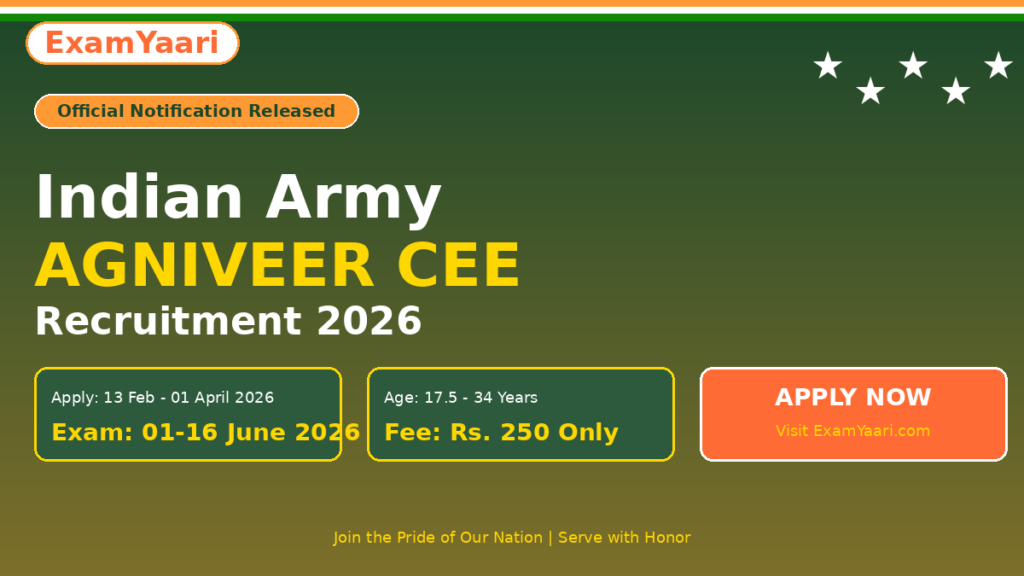
The Indian Army (Bhartiya Sena) has officially announced the much-awaited Agniveer Common Entrance Exam (CEE) Recruitment 2026 notification on its official website. This recruitment drive under the Agnipath scheme offers a golden opportunity for young Indian citizens to serve the nation and build a prestigious career in the Indian Armed Forces. The online application process commenced on 13th February 2026 and will continue until 1st April 2026.

Indian Army Agniveer CEE Recruitment 2026

In this comprehensive guide, we will cover everything you need to know about the Indian Army Agniveer CEE Recruitment 2026, including important dates, eligibility criteria, age limits, educational qualifications, physical standards, application fees, selection process, and step-by-step instructions on how to apply online.

Indian Army Agniveer CEE 2026: Quick Overview

ParticularsDetails
Organization NameIndian Army (Bhartiya Sena)
Recruitment NameAgniveer Common Entrance Exam (CEE) 2026
Post CategoryAgniveer GD, Technical, Tradesman, Clerk, Nursing Assistant, JCO Religious Teacher
Application ModeOnline
Application Start Date13th February 2026
Application Last Date1st April 2026
Fee Payment Last Date2nd April 2026
Exam Date1st June to 16th June 2026
Official Websitejoinindianarmy.nic.in

Important Dates for Indian Army Agniveer CEE Recruitment 2026

Aspiring candidates must carefully note all the critical dates related to the Indian Army Agniveer CCE Recruitment 2026 to ensure they don’t miss any important deadlines:

  • Online Application Start Date: 13th February 2026
  • Online Application Last Date: 1st April 2026
  • Last Date for Fee Payment: 2nd April 2026
  • Examination Date: 1st June 2026 to 16th June 2026
  • Admit Card Release: Before the examination (to be notified)
  • Result Declaration: To be updated soon on the official website

Note: Candidates are strongly advised to regularly check the official Indian Army website for any updates or changes to these dates.

Age Limit for Indian Army Agniveer CEE 2026 (As on 1st July 2026)

The age criteria for different categories under the Agniveer recruitment 2026 vary based on the position applied for. Here are the detailed age requirements:

Age Requirements by Post:

  • Agniveer General Duty (GD) / Technical / Assistant / Tradesman: 17.5 to 21 years
    (Date of Birth: 1st October 2005 to 1st April 2009)
  • Soldier Technical: 17.5 to 23 years
    (Date of Birth: 1st October 2004 to 1st April 2009)
  • Sepoy Pharma: 19 to 25 years
    (Date of Birth: 1st October 2002 to 1st April 2008)
  • Junior Commissioned Officer (JCO) Religious Teacher: 27 to 34 years as on 1st July 2026

Age Relaxation: The Indian Army provides age relaxation for reserved categories as per government regulations. Candidates from SC/ST/OBC and other eligible categories should refer to the official notification for specific relaxation details.

Educational Qualification & Eligibility Criteria for Agniveer Posts 2026

The educational qualifications required for various positions under the Indian Army Agniveer recruitment 2026 differ based on the specific role. Here’s a comprehensive breakdown:

1. Agniveer General Duty (GD)

  • Educational Qualification: Class 10th (Matriculation) with 45% marks and minimum 33% in each subject
  • Note: For boards following grading system, minimum ‘D’ grade (33%-40%) in individual subjects with overall ‘C2’ grade equivalent to 45% aggregate
  • Special Provision: Indian Gorkhas require only Class 10th simple pass

2. Agniveer Technical

  • Educational Qualification (Option 1): 10+2 Intermediate in Science stream with Physics, Chemistry, Mathematics, and English with minimum 50% marks in aggregate and 40% in each subject
  • Educational Qualification (Option 2): 10+2 Intermediate from any recognized board with 1-year ITI course

3. Agniveer (Office Assistant / Store Keeper Technical)

  • Educational Qualification: 10+2 Intermediate in any stream with minimum 60% marks in aggregate and minimum 50% marks in each subject
  • Mandatory: Securing 50% marks in English and Mathematics/Accounts/Book Keeping in Class XII is compulsory

4. Agniveer Tradesman (10th Pass)

  • Educational Qualification: Class 10th passed from any recognized board in India with minimum 33% in each subject

5. Agniveer Tradesman (8th Pass)

  • Educational Qualification: Class 8th passed from any recognized board in India with minimum 33% in each subject

6. Agniveer General Duty (Women Military Police)

  • Educational Qualification: Class 10th/Matriculation with minimum 45% marks in aggregate and minimum 33% in each subject
  • Preference: Candidates with valid Light Motor Vehicle (LMV) Driving License will be given preference for driver requirements

7. Sepoy Pharma

  • Educational Qualification (Option 1): 10+2 equivalent and qualified in D.Pharma with minimum 55% in aggregate, registered with State Pharmacy Council/Pharmacy Council of India
  • Educational Qualification (Option 2): B.Pharma qualified with minimum 50% marks and registered with State Pharmacy Council/Pharmacy Council of India

8. Soldier Technical Nursing Assistant

  • Educational Qualification (Option 1): 10+2 Intermediate in Science with Physics, Chemistry, Biology, and English with minimum 50% marks in aggregate and minimum 40% in each subject
  • Educational Qualification (Option 2): 10+2 Intermediate in Science with Physics, Chemistry, Botany, Zoology, and English with minimum 50% marks in aggregate and minimum 40% in each subject

9. JCO Religious Teacher

The requirements vary based on religion:

  • RT Pandit/Pandit Gorkha (Hindu): Shashtri/Acharya in Sanskrit with Karam Kand as main/core subject OR one-year diploma in Karam Kand
  • Granthi (Sikh): Bachelor’s degree in any stream with ‘Gyani’ in Punjabi
  • Padre (Christian): Bachelor’s degree in any stream, ordained priesthood by appropriate ecclesiastical authority and approved by local Bishop
  • Maulvi Shia (Muslim): Bachelor’s degree in any stream with Alim in Arabic or Adeeb-e-Mahir/Urdu Mahir in Urdu
  • RT Buddhist: Bachelor’s degree in any stream, ordained Monk/Buddhist Priest by appropriate authority with Geshe (PhD) of Khanpa or Lopon or Rabjam

Physical Eligibility Standards for Indian Army Agniveer 2026

Physical fitness is a crucial component of the Indian Army Agniveer selection process. Candidates must meet specific physical standards to qualify:

Physical Standards for Group I (Most Agniveer Posts):

  • Height:
    • General Candidates: 169 cm
    • Technical/Office Assistant: 162 cm
    • Women Military Police: 162 cm
  • Chest: 77 cm (with 5 cm expansion)
  • Running: 1.6 km in 5 minutes 45 seconds – 60 Marks
    • For Women Military Police: 1.6 km in 7 minutes 30 seconds
  • Pull-ups: 10 times – 40 Marks (Needed to qualify for some posts)
  • 9 Feet Ditch: Needed to Qualify
  • Zigzag Balance: Needed to Qualify

Physical Standards for Women Military Police:

  • Height: 162 cm
  • Long Jump: 10 feet
  • High Jump: 3 feet
  • Running: 1.6 km in 7 minutes 30 seconds

Physical Standards for JCO Religious Teacher:

  • Height: General – 160 cm, Gorkhas & Ladakhi Region – 157 cm
  • Chest: 77 cm (with 5 cm expansion)
  • Running: 1.6 km in 8 minutes

Important: Physical standards may vary slightly based on category and region. Candidates should refer to the official notification for complete details.

Application Fee for Indian Army Agniveer CEE 2026

All candidates applying for the Indian Army Agniveer recruitment 2026 must pay the prescribed application fee:

  • For General/OBC/EWS Candidates: ₹250/-
  • For SC/ST Candidates: ₹250/-

Payment Methods Available:

Candidates can make the payment online using any of the following secure methods:

  • Debit Card
  • Credit Card
  • Internet Banking
  • IMPS (Immediate Payment Service)
  • Cash Card/Mobile Wallet

Last Date for Fee Payment: 2nd April 2026

How to Apply for Indian Army Agniveer CEE Recruitment 2026

The application process for Agniveer CEE 2026 is entirely online. Follow these step-by-step instructions to complete your application successfully:

Step-by-Step Application Process:

  1. Visit the Official Website: Go to the official Indian Army recruitment portal at joinindianarmy.nic.in
  2. New User Registration: If you’re a first-time user, click on the “Registration” link and create your account by providing:
    • Basic personal details
    • Valid email ID
    • Active mobile number
    • Create a strong password
  3. Verify Your Account: Check your email and mobile for OTP (One-Time Password) and verify your registration
  4. Login to Your Account: Use your registration credentials to log in to the application portal
  5. Fill the Application Form: Complete all sections of the application form accurately:
    • Personal Information
    • Educational Qualifications
    • Category Details
    • Post Preference
    • Physical Measurements
  6. Upload Required Documents: Scan and upload the following documents in prescribed format:
    • Recent passport-size photograph
    • Signature
    • Educational certificates
    • Category certificate (if applicable)
    • ID proof
  7. Pay Application Fee: Complete the fee payment using any of the available online payment methods
  8. Review and Submit: Carefully review all entered information, make necessary corrections, and submit the form
  9. Save Confirmation: Download and print the application confirmation page for future reference
  10. Note Down Application Number: Keep your application number safe as it will be required for all future correspondence

Important Instructions Before Applying:

  • Read the official notification carefully before starting the application
  • Keep all required documents scanned and ready
  • Ensure stable internet connection during application
  • Use the latest version of web browsers (Chrome, Firefox, etc.)
  • Keep your registration details confidential
  • Apply well before the deadline to avoid last-minute technical issues

Selection Process for Indian Army Agniveer CEE 2026

The selection of candidates for Agniveer posts involves a comprehensive multi-stage process designed to assess both physical and mental capabilities:

Stages of Selection:

  1. Written Examination (Common Entrance Exam):
    • Computer-based test covering General Knowledge, Mathematics, English, and Reasoning
    • Scheduled between 1st June to 16th June 2026
    • Merit list prepared based on exam performance
  2. Physical Efficiency Test (PET):
    • Running test (1.6 km)
    • Pull-ups/beam exercises
    • 9-feet ditch crossing
    • Zigzag balance test
  3. Physical Standard Test (PST):
    • Height measurement
    • Chest measurement (for male candidates)
    • Weight verification
  4. Document Verification:
    • Verification of educational certificates
    • Identity proof verification
    • Category certificate verification (if applicable)
    • Original documents required
  5. Medical Examination:
    • Comprehensive medical fitness test
    • Vision test
    • General health assessment
    • Final fitness clearance

Documents Required for Indian Army Agniveer Recruitment 2026

Candidates must keep the following documents ready in original and photocopies for verification:

  • Class 10th Mark Sheet and Certificate
  • Class 12th Mark Sheet and Certificate (if applicable)
  • Degree/Diploma certificates (for specific posts)
  • Date of Birth Certificate
  • Aadhar Card
  • PAN Card (optional)
  • Category Certificate (SC/ST/OBC) if applicable
  • Domicile Certificate
  • Character Certificate
  • Recent passport-size photographs (multiple copies)
  • Professional registration certificates (for Pharma/Nursing posts)
  • Driving License (if applicable)

Exam Pattern for Agniveer CEE 2026

While the detailed exam pattern will be provided in the official notification, the Common Entrance Exam typically covers:

  • General Knowledge: Current affairs, Indian history, geography, polity, economy, science
  • Mathematics: Basic arithmetic, algebra, geometry
  • English Language: Grammar, vocabulary, comprehension
  • General Intelligence & Reasoning: Logical reasoning, analytical ability

The examination will be conducted in computer-based mode, and the duration and marking scheme will be specified in the admit card.

Preparation Tips for Indian Army Agniveer CEE 2026

To excel in the Agniveer recruitment exam, candidates should follow these preparation strategies:

Academic Preparation:

  • Study the complete syllabus systematically
  • Focus on strengthening basics in Mathematics and English
  • Stay updated with current affairs and general knowledge
  • Practice previous year question papers
  • Take regular mock tests to improve time management
  • Analyze your weak areas and work on improvements

Physical Preparation:

  • Start physical training at least 3-4 months before the exam
  • Practice daily running to improve stamina
  • Work on pull-ups and strength training
  • Maintain proper diet and nutrition
  • Get adequate sleep and rest
  • Avoid smoking and alcohol consumption
  • Practice under supervision for ditch crossing and balance tests

Benefits of Joining Indian Army as Agniveer

The Agnipath scheme offers numerous benefits to young aspirants:

  • Attractive Salary Package: Competitive monthly salary with annual increments
  • Seva Nidhi Package: Substantial corpus fund after completion of service
  • Skill Development: Training in various technical and professional skills
  • Career Opportunities: Opportunity for permanent enrollment based on performance
  • Educational Benefits: Support for further education after service
  • Medical Facilities: Comprehensive healthcare for self and family
  • Prestige and Honor: Serve the nation with pride and dignity
  • Personal Growth: Develop discipline, leadership, and life skills

Frequently Asked Questions (FAQs) About Indian Army Agniveer CEE 2026

When did the online application for Indian Army Agniveer CEE Recruitment 2026 start?

The online application process started on 13th February 2026.

What is the last date to apply for Indian Army Agniveer CEE 2026?

The last date for online application is 1st April 2026.

What is the age limit for Indian Army Agniveer recruitment 2026?

The minimum age is 17.5 years and the maximum age ranges from 21 to 34 years (post-wise) as on 1st July 2026.

What is the application fee for Agniveer CEE 2026?

The application fee is ₹250/- for all categories (General/OBC/EWS/SC/ST).

When will the Agniveer CEE exam be conducted?

The examination will be held between 1st June to 16th June 2026.

What is the official website for Indian Army recruitment?

The official website is joinindianarmy.nic.in

Is there negative marking in the Agniveer CEE exam?

The detailed marking scheme will be mentioned in the official notification and admit card.

Can I apply for multiple posts in the same application?

Yes, candidates can select multiple post preferences based on their eligibility during the application process.

Is physical training mandatory before the exam?

While not mandatory before the written exam, candidates must be physically fit to clear the PET/PST after the written test.

What documents are required at the time of document verification?

Candidates must carry original educational certificates, date of birth proof, category certificates, identity proof, and photographs during document verification.

Final Words

The Indian Army Agniveer CEE Recruitment 2026 is an excellent opportunity for patriotic young Indians to serve their nation with honor and pride. The Agnipath scheme provides a structured pathway to join the prestigious Indian Armed Forces with modern training, competitive compensation, and career growth opportunities.

Interested and eligible candidates should carefully read the official notification, verify their eligibility criteria, and complete the online application before the deadline of 1st April 2026. Remember to start your physical preparation alongside academic studies to ensure success in all stages of the selection process.

Don’t miss this chance to wear the uniform and serve your motherland. Apply today and take the first step toward an honorable career in the Indian Army!

Disclaimer: All the information provided in this article is based on the official notification released by the Indian Army. Candidates are advised to visit the official website regularly for any updates or changes. ExamYaari is not responsible for any inadvertent errors or changes made by the recruiting authority.

Stay updated with the latest government job notifications, exam results, and admit cards by bookmarking our website!

Related Searches: Indian Army Recruitment 2026, Agniveer Bharti 2026, Join Indian Army, Army Agniveer Application Form, Indian Army Vacancy 2026, Agniveer CEE Exam Date, Indian Army Physical Test, Agnipath Scheme 2026, Indian Army Eligibility Criteria, How to Join Indian Army 2026

Bihar Police CSBC Constable Recruitment 2026

Bihar Police CSBC Constable Recruitment 2026, Exam Yaari , Latest Govt Jobs, Sarkari Result,

Bihar Police CSBC Constable Recruitment 2026

Complete Guide: Application Form, Eligibility, Exam Pattern & Important Dates

The Central Selection Board of Constable (CSBC), Bihar, has announced a golden opportunity for aspiring candidates to join the Bihar Police force. The Bihar Police CSBC Constable Recruitment 2026 notification has been released on the official website for 83 constable positions. This comprehensive recruitment drive aims to fill vacant positions in the Bihar Police Department and offers a promising career path for eligible candidates across the state.

The online application process has already commenced from February 6, 2026, and interested candidates can submit their applications until March 5, 2026. This article provides complete information about the Bihar Police CSBC Constable Vacancy 2026, including eligibility criteria, application process, selection procedure, and other essential details.

Bihar Police CSBC Constable 2026: Quick Overview

Recruiting OrganizationCentral Selection Board of Constable (CSBC), Bihar
Post NameBihar Police Constable
Total Vacancies83 Posts
Advertisement Number01/2026
Application ModeOnline
Application Start DateFebruary 6, 2026
Last Date to ApplyMarch 5, 2026
Application Fee₹100 (All Categories)
Official Websitehttps://csbc.bihar.gov.in/

Important Dates for Bihar Police CSBC Constable Recruitment 2026

Candidates must keep track of the following important dates to ensure they don’t miss any crucial deadlines for the Bihar Police CSBC Constable Bharti 2026:

EventDate
Online Application Start DateFebruary 6, 2026
Online Application Last DateMarch 5, 2026
Last Date for Fee PaymentMarch 5, 2026
Examination DateTo be notified later
Admit Card ReleaseBefore examination
Result DeclarationWill be updated soon

Bihar Police CSBC Constable Vacancy Details 2026

The Central Selection Board of Constable has announced a total of 83 vacancies for the Constable position in Bihar Police. This recruitment drive offers an excellent opportunity for candidates aspiring to serve in the police department.

Post NameNumber of Posts
Bihar Police CSBC Constable83 Posts

Educational Qualification for Bihar Police Constable 2026

Candidates applying for the Bihar Police CSBC Constable position must meet the following educational requirements:

  • Candidates must have passed 10+2 (Intermediate) examination from any recognized board or university in India
  • The intermediate certificate should be from a board recognized by the Government of India or State Government
  • For complete and detailed eligibility criteria, candidates are advised to read the official notification carefully

Note: Candidates should verify their educational qualifications from the official notification before applying, as specific stream or subject requirements may apply.

Age Limit for Bihar Police CSBC Constable 2026

The age criteria for Bihar Police CSBC Constable recruitment is calculated as on August 1, 2026. The age limits vary according to category and gender:

CategoryMinimum AgeMaximum Age
All Categories18 Years
UR (Male & Female)18 Years25 Years
BC, EBC (Male)18 Years27 Years
BC, EBC (Female)18 Years28 Years
SC, ST (Male & Female)18 Years30 Years

Important: Age relaxation is provided as per Bihar Police regulations. The age is calculated as on August 1, 2026.

Physical Standards for Bihar Police Constable 2026

Candidates must meet the following physical requirements to be eligible for the Bihar Police CSBC Constable position:

Height Requirements

CategoryMaleFemale
General / BC165 cms155 cms
Other Categories160 cms155 cms

Chest Measurement (For Male Candidates)

CategoryChest Measurement
General / BC81-86 cms (Unexpanded-Expanded)
Other Categories79-84 cms (Unexpanded-Expanded)

Weight Requirements

Minimum weight for female candidates: 48 kg

Application Fee for Bihar Police CSBC Constable 2026

The application fee structure for Bihar Police CSBC Constable Recruitment 2026 is uniform across all categories:

  • Application Fee: ₹100 for all categories (General, OBC, SC, ST, EBC, etc.)
  • Last Date for Fee Payment: March 5, 2026

Payment Methods

Candidates can pay the application fee online through the following modes:

  • Debit Card
  • Credit Card
  • Internet Banking
  • IMPS
  • Cash Card / Mobile Wallet

Selection Process for Bihar Police CSBC Constable 2026

The selection of candidates for Bihar Police CSBC Constable positions will be based on a multi-stage process. Candidates must qualify at each stage to proceed to the next level:

Stage 1: Written Examination

The first stage involves a written examination that will test the candidates’ knowledge in various subjects. The exam pattern and syllabus will be available in the official notification. Candidates who qualify in the written exam will be called for the next stage.

Stage 2: Physical Standards Test (PST)

Candidates who clear the written examination will undergo Physical Standards Test to verify their height, chest (for males), and weight measurements as per the prescribed standards mentioned above.

Stage 3: Document Verification

Candidates who qualify in the PST will be called for document verification. All original documents related to age, educational qualification, category certificate, and other relevant documents must be produced for verification.

Stage 4: Medical Examination

The final stage involves a comprehensive medical examination to ensure candidates are medically fit for police service. Only those who are declared medically fit will be considered for final selection.

How to Apply for Bihar Police CSBC Constable Online Form 2026

Candidates interested in applying for Bihar Police CSBC Constable positions should follow these step-by-step instructions to complete their online application:

Step-by-Step Application Process

  • Visit the official website of CSBC Bihar at https://csbc.bihar.gov.in/
  • Look for the Bihar Police CSBC Constable Recruitment 2026 notification link on the homepage
  • Read the complete official notification carefully before proceeding with the application
  • Click on the ‘Apply Online’ link for Bihar Police CSBC Constable Recruitment 2026
  • If you are a new user, complete the registration process by providing basic details
  • After registration, log in using your credentials
  • Fill in the application form with accurate personal, educational, and other required details
  • Upload scanned copies of your recent photograph and signature as per the specified format and size
  • Pay the application fee of ₹100 through any of the available online payment modes
  • Review all the entered information carefully before final submission
  • Submit the application form and save the confirmation page
  • Take a printout of the completed application form for future reference

Important: Complete your application before the deadline of March 5, 2026. Late applications will not be accepted under any circumstances.

Important Instructions for Candidates

  • Candidates are strongly advised to read the official notification thoroughly before filling out the application form
  • Pay special attention to last date, age limit, and educational qualification requirements
  • Ensure that all uploaded documents are clear, legible, and in the specified format
  • Keep scanned copies of all required documents ready before starting the application process
  • Verify all information before final submission as corrections may not be allowed later
  • Save your application number and password for future login and tracking purposes
  • Regularly check the official website for updates regarding admit card, exam date, and results

Frequently Asked Questions (FAQs)

Q1. When did the online application for Bihar Police CSBC Constable Recruitment 2026 start?

Answer: The online application for Bihar Police CSBC Constable Recruitment 2026 started on February 6, 2026.

Q2. What is the last date to apply for Bihar Police CSBC Constable Online Form 2026?

Answer: The last date for submitting the online application form is March 5, 2026. Candidates must complete their application before this deadline.

Q3. What is the age limit for Bihar Police CSBC Constable Bharti 2026?

Answer: The minimum age requirement is 18 years and the maximum age varies by category: 25 years for UR candidates (Male & Female), 27 years for BC/EBC Male, 28 years for BC/EBC Female, and 30 years for SC/ST candidates (Male & Female). Age is calculated as on August 1, 2026.

Q4. What is the educational qualification required for Bihar Police CSBC Constable Vacancy 2026?

Answer: Candidates must have passed 10+2 (Intermediate) examination from any recognized board or university in India. For complete eligibility details, please refer to the official notification.

Q5. What is the official website for Bihar Police CSBC?

Answer: The official website for Bihar Police CSBC is https://csbc.bihar.gov.in/. Candidates should visit this website for official notifications, application forms, and updates.

Q6. How many vacancies are available for Bihar Police CSBC Constable 2026?

Answer: A total of 83 vacancies have been announced for Bihar Police CSBC Constable positions in this recruitment drive.

Q7. What is the application fee for Bihar Police CSBC Constable 2026?

Answer: The application fee is ₹100 for all categories. Payment can be made through various online modes including debit card, credit card, internet banking, IMPS, or mobile wallet.

Q8. What is the selection process for Bihar Police CSBC Constable 2026?

Answer: The selection process consists of four stages: Written Examination, Physical Standards Test (PST), Document Verification, and Medical Examination. Candidates must qualify at each stage to proceed further.

Conclusion

The Bihar Police CSBC Constable Recruitment 2026 presents an excellent opportunity for candidates aspiring to serve in the Bihar Police Department. With 83 vacancies announced and a straightforward application process, eligible candidates should not miss this chance to build a rewarding career in law enforcement.

Candidates are advised to prepare thoroughly for the written examination while ensuring they meet all physical standards. The application deadline of March 5, 2026, is approaching, so interested candidates should complete their applications at the earliest to avoid last-minute technical issues.

For the most accurate and updated information, candidates should regularly visit the official CSBC Bihar website at https://csbc.bihar.gov.in/. We wish all aspiring candidates the very best for their Bihar Police CSBC Constable Recruitment 2026 journey!

Disclaimer: This article is for informational purposes only. Candidates must verify all details from the official notification and website before applying. All information is subject to change as per official announcements.
Bihar Police BPSSC SI Prohibition Exam Syllabus & Pattern 2026 — Complete Guide

The Bihar Police Subordinate Services Commission (BPSSC) conducts the Sub‑Inspector (SI) Prohibition exam as part of its recruitment process for eligible candidates. Along with meeting the eligibility criteria, understanding the syllabus and exam pattern is crucial for strategic preparation and success in the competitive exam. This article breaks down the exam stages, marking scheme, subjects, and topic‑wise syllabus to help you prepare with clarity.

Overview of Exam Stages

The BPSSC SI Prohibition selection process includes three major stages:

  1. Preliminary Examination (Prelims)
  2. Main Written Examination (Mains)
  3. Physical Efficiency/Standard Test (PET/PST)

Candidates must clear each written stage to qualify for the next round.

BPSSC SI Prohibition Exam Pattern 2026

Understanding the structure of the exam helps candidates plan their preparation schedule more effectively. The exam pattern is divided into Prelims and Mains.

Preliminary Exam Pattern

ComponentDetails
SubjectGeneral Knowledge & Contemporary Issues
TypeObjective (Multiple Choice Questions)
Questions100
Marks200
Exam Duration2 Hours (120 minutes)
Negative MarkingYes (Approximately 0.2 marks per wrong answer)
Qualifying StatusMinimum 30% required to qualify

Note: Scores in Prelims are used only to shortlist candidates for the Mains exam.

Main Written Examination Pattern

The Mains stage consists of two papers:

PaperSubjectQuestionsTotal MarksDuration
Paper‑IGeneral Hindi1002002 Hours
Paper‑IIGeneral Studies & Other Subjects1002002 Hours

🔹 Paper‑I (General Hindi) is qualifying in nature — meaning you must score the minimum required marks (generally 30%) to pass, but its marks are not counted for final ranking.

🔹 Paper‑II is used for final merit list calculation.

Detailed Syllabus Breakdown

Below is a subject‑wise breakdown of the topics covered in both Prelims and Mains stages of the BPSSC SI Prohibition examination.

Prelims Syllabus

The Prelims exam focuses on General Knowledge & Contemporary Issues, including:

  • National & International Current Affairs
  • General Awareness
  • Sports & Awards
  • Important Facts and Figures
  • Renowned Personalities
  • Full Forms & Abbreviations
  • History & Culture
  • Geography (Basic concepts)
  • Economics & Politics (General)
  • Scientific and Technological Updates

This stage tests your awareness of real‑world events and basic general knowledge, which is essential for building a strong foundation for the Mains exam.

Mains Exam Syllabus

The Mains exam has two papers:


Paper‑I – General Hindi

This paper assesses language skills and understanding of Hindi grammar. Major topic areas include:

  • Reading Comprehension
  • Fill in the Blanks
  • Sentence Correction
  • Cloze Test
  • Grammar topics:
    • Sandhi, Samas
    • Synonyms & Antonyms
    • Gender & Number
    • Karak & Vibhakti
    • Pronoun & Verb usage
    • Word Formation
    • Idioms & Phrases

These topics evaluate your command over Hindi writing and grammar.

Paper‑II – General Studies & Other Subjects

This paper covers a broader range of subjects, including:

General Studies & General Science
  • Basic physical and life sciences
  • Motion, force, energy
  • Structures of the atom and molecules
  • Acids, bases, salts
  • Light & sound
  • Pollution and environment
  • Natural resources and phenomena
Mathematics & Mental Ability
  • Number system and basic arithmetic operations
  • Ratio & proportion
  • Profit & Loss, Discount
  • Percentage, Average
  • Data Interpretation
  • Algebra & Puzzles
  • Figure Series, Odd One Out
  • Syllogism, Analogies
  • Blood relations
Civics & Indian Polity
  • Constitution basics
  • Central and state government roles
  • Judiciary and law enforcement
  • Social justice and media understanding
Indian History & Culture
  • Revolt of 1857 and freedom movement
  • Sultans of Delhi and kingdom histories
  • Culture and science contributions
  • India after independence
Indian Geography
  • Earth in the solar system
  • Human environment
  • Natural resources and agriculture
  • Political maps of India
  • Air and water systems

This combined syllabus ensures candidates have a solid grasp of multiple subjects essential for policing and law enforcement roles.

Preparation Tips for BPSSC Prohibition SI

While preparing for the exam pattern and syllabus:

  • Focus on current affairs and general awareness every day.
  • Practice Hindi grammar exercises and comprehension passages.
  • Solve previous year MCQs to understand question types.
  • Take mock tests to improve time management.
  • Revise basic mathematics and reasoning regularly.

Important Notes

  • The Preliminary exam qualifying marks are typically required to be at least 30%. Candidates scoring below this may not be allowed to appear in the Main written exam.
  • Paper‑I of Mains (General Hindi) is qualifying and does not directly affect the final merit list.
  • Paper‑II (General Studies) determines the final ranking for selection.

Conclusion

The BPSSC SI Prohibition exam 2026 demands a strategic preparation plan. By understanding the syllabus and exam pattern thoroughly — from Prelims to Mains — candidates can approach their studies with confidence and clarity. Whether you’re revising current affairs, practicing Hindi grammar, or working on reasoning and general science, every topic has its significance. Start early, maintain consistency, and use mock tests to sharpen your performance before the exam day.